First Quarter: Weaving the Nine Herbs' Charm
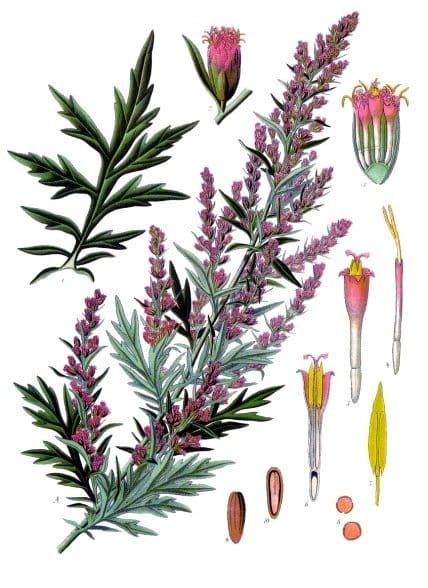
Hello. It's Friday, and lately we have begun to harvest tomatoes, and we found our first new potato, and the nearby farms have blueberries, raspberries, peaches. The autumn carrots are planted. The air is rich with dragonflies. We have not yet had enough rain to break our critical drought, but rain at least keeps passing through here and there. The heat of the day is strong but comfortably lazy, rather than an oppressively humid nightmare. With enough shade and a breeze, I can still spend time in the garden, and I've been loving the progress of our new herb bed, and I've also been intrigued by a volunteer arrival in our flower bed, which is mugwort.
I don't want this mugwort to stay where it currently is, since I'd rather tend it near the other ritual herbs and it also grows so aggressively that its current position will make it spread over our septic tank cover if we leave it unchecked. So I intend to dig it up. However, I will probably wait a couple of months until the plant is more mature, then divide the roots of what I pull: half can be dried and saved for medicinal experimentation or ritual burning, and the other half can be propagated somewhere better. Although mugwort is a somewhat potent autumn allergen, its pollen spreads less widely than that of ragweed, and the allergic factor can be solved by just cutting the flowers off. I would very much like to have mugwort on hand because of its history in Euro-traditional herbalism — among other traditions — as a sleep aid, antiparasitic, and significant plant for reproductive medicine, with folk knowledge and some limited scientific data pointing toward mugwort's value in inducing uterine contractions, which might help anyone trying to regulate menses, conduct an abortion, or induce labor.
In saying so, I do not mean I am personally certain that mugwort can do these things, nor do I recommend using any herb in a high stakes situation where unclear dosing could at best waste time and at worst do serious damage. But as I've indicated in past writings, I keep exploring herbalism for more complicated reasons than just trying to do 1:1 replacement for pharmaceutical drugs. I find it wise to use minor ailments as an excuse for reweaving relation with plantlife, generally pairing the emphasis on minor ailments with plants whose most likely effects are not very intense and thus hard to overdo if consumed in moderation; I also find it wise to learn ethnobotanical lore and experiment in non-desperate circumstances just in case I ever find myself thinking, "Any port in a storm," as access to a certain pharmaceutical is ever cut off, temporarily or permanently. And where mugwort is concerned, its arrival right outside the door feels very appropriate to the uterine phenomena in my life that are reaching a distinctive culmination this summer.
I probably shouldn't turn this guest away. Even if the timing were different, I still wouldn't. Mugwort has such a rich history alongside humans across Eurasia that it's increasingly a plant favored for smoke purification work by Euro-descended settler witches who are already aware of how we should not be stealing white sage. And for those of us who engage with the animism of the early English people — whether as our direct ancestors or as a culturally imposed psycholinguistic substrate — mugwort holds special importance as the first of nine plants belonging to the 10th century Old English magical-medicinal poem Nigon Wyrta Galdor, or the Nine Herbs Charm.
I am writing today to share that poem with those of you who are unfamiliar, because it's a powerful series of verses if you practice any sort of hedgecraft, green witchery, Germanic ancestor work, or rites that overlap. I will first share the Old English text untranslated in its entirety, then I will link you to several people's translations, and then I will dissect my own takeaway about the mentioned herbs and the salve for which they would apparently be used.
The poem
As a modern English speaker, do not try to understand the text directly, but try reading it without thinking too hard about it. Read aloud if you wish. The ð is pronounced as in "the," the þ is pronounced as in "thin," the ƿ is pronounced as in "win," the æ is pronounced more or less as in "cat," and the y is a tight sound like the French "u" if you know that vowel. Most other sound differences from our modern language would be too involving to explain here, but if you have those five sounds under your belt and remember that an e at the end of a word does actually get pronounced, you can fumble your way through an approximation of Old English without getting tripped up by too many confusing letters. (The parts that look like Roman numerals, by the way, are indeed Roman numerals because the early English did sometimes adopt them in written use.)
As you read, allow your mind to free-associate what the words look or sound like even if you doubt how accurate the association may be. I have put some words in bold that we will come back to.
Gemyne ðu mucgƿyrt
hƿæt þu ameldodest
hƿæt þu renadest æt Regenmelde
Una þu hattest yldost ƿyrta
þu miht ƿið III & ƿið XXX
þu miht ƿiþ attre & ƿið onflyge
þu miht ƿiþ þa[m] laþan ðe geond lond færð
Ond þu ƿegbrade ƿyrta modor
east[a]n op[e]ne inn[a]n mihtigu
ofer ðy cræte curran ofer ðy cƿene reodan
ofer ðy bryde bryodedon ofer ðy fearras fnærdon.
Eallum þu þon ƿiðstode and ƿiðstunedest
swa ðu ƿiðstonde attre and onflyge
and þæm laðan þe geond lond fereð:
Stune hætte þeos ƿyrt, heo on stane geƿeox
stond heo ƿið attre, stunað heo ƿærce
Stiðe heo hatte, ƿiðstunað heo attre
ƿreceð heo ƿraðan, ƿeorpeð ut attor
Þis is seo ƿyrt seo ƿiþ ƿyrm gefeaht
þeos mæg ƿið attre, heo mæg ƿið onflyge
heo mæg ƿið ða[m] laþan ðe geond lond fereþ
Fleoh þu nu attorlaðe, seo læsse ða maran
seo mare þa læssan, oððæt him beigra bot sy
Gemyne þu, mægðe,
hƿæt þu ameldodest
hƿæt ðu geændadest æt Alorforda
þæt næfre for gefloge feorh ne gesealde
syþðan him mon mægðan to mete gegyrede
Þis is seo ƿyrt ðe wergulu hatte
ðas onsænde seolh ofer sæs hrygc
ondan attres oþres to bote
Ðas VIIII [m]agon ƿið nygon attrum.
Ƿyrm com snican, toslat he nan
ða genam Ƿoden VIIII ƿuldortanas
sloh ða þa næddran þæt heo on VIIII tofleah
Þær geændade æppel and attor
þæt heo næfre ne ƿolde on hus bugan
Fille and finule, felamihtigu twa
þa ƿyrte gesceop ƿitig drihten
halig on heofonum, þa he hongode
sette and sænde on VII ƿorulde
earmum and eadigum eallum to bote
Stond heo ƿið ƿærce, stunað heo ƿið attre
seo mæg ƿið III & wið XXX
ƿið [feondes] hond and ƿið frea b[r]egde
ƿið malscrunge m[a]nra wihta
Nu magon þas VIIII ƿyrta ƿið nygon ƿuldorgeflogenum
ƿið VIIII attrum and ƿið nygon onflygnum
ƿið ðy readan attre, ƿið ð[y] runlan attre
ƿið ðy hƿitan attre, ƿið ðy [hæƿe]nan attre
ƿið ðy geolwan attre, ƿið ðy grenan attre
ƿið ðy ƿonnan attre, ƿið ðy ƿedenan attre
ƿið ðy brunan attre, ƿið ðy baseƿan attre
ƿið ƿyrmgeblæd, ƿið ƿætergeblæd
ƿið þorngeblæd, ƿið þystelgeblæd
ƿið ysgeblæd, ƿið attorgeblæd
Gif ænig attor cume eastan fleogan
oððe ænig norðan cume
oððe ænig westan ofer ƿerðeode
Crist stod ofer a[dl]e ængan cundes
Ic ana ƿat ea rinnende
þær þa nygon nædran behealdað
Motan ealle weoda nu ƿyrtum aspringan
sæs toslupan, eal sealt ƿæter
ðonne ic þis attor of ðe geblaƿe
Mucgƿyrt, ƿegbrade þe eastan open sy, lombescyrse, attorlaðan, mageðan, netelan, ƿudusuræppel, fille & finul, ealde sapan. Geƿyrc ða ƿyrta to duste, mængc ƿiþ þa sapan and ƿiþ þæs æpples gor.
Ƿyrc slypan of ƿætere and of axsan, genim finol, ƿyl on þære slyppan and beþe mid æggemongc, þonne he þa sealfe on do, ge ær ge æfter.
Sing þæt galdor on æcre þara ƿyrta, III ær he hy ƿyrce and on þone æppel ealsƿa; ond singe þon men in þone muð and in þa earan buta and on ða ƿunde þæt ilce gealdor, ær he þa sealfe on do.
Basic textual analysis
It can certainly help to have a linguistics background like my own, especially one that focuses on English historical linguistics or on other Germanic languages that have developed in parallel. Nonetheless, going by my first experiences attempting to read Old English before I had the same grounding, I suspect that it's unusual for a layperson to read that text and — assuming they're willing to stubborn their way through it in the first place — not identify a few words that look or sound extremely familiar. Even without focusing on specific vocabulary, when read aloud there is also a pulsing cadence that can come very naturally to a modern English speaker because that rhythm still forms the backbone to our own speech patterns, most of all in poetry.
But all right: I am not an actual scholar of Old English and I cannot reliably translate any of it myself. If you are curious to learn more about it, there are some directions I can point you[1], but for now I am just going to share some other people's translations of the text for you to read and compare.
Translation by Karen Louise Jolly
Translation by Ophelia Hostetter - scroll down slightly for this one
Translation by Joseph S. Hopkins
The last one is the most recent and also my favorite of the three.[2] The translator's notes are particularly valuable, highlighting how the actual verse section appears to be the galdor or sung charm itself, meant to be sung over the herbs as they are prepared, and then it is followed by a prose recipe that lists concrete ingredients and what the preparation should involve. And I prefer Hopkins' matching of the herbs mentioned in the sung portion to the herbs mentioned in the ingredients, as follows:
mucgƿyrt - mugwort
ƿegbrade ("that opens to the east") - literally "waybread" but understood to mean plantain, the plant I brought up a couple weeks ago
stune or stiðe (verse) / lombescyrse (prose) - lamb's cress, a.k.a. hairy bittercress
attorlaðe - literally "venom-loathe," which Hopkins does not translate and which seemingly nobody can identify as a specific herb; when I send myself down others' speculative rabbit holes the strongest preferences appear to be for betony or black nightshade, substantiated by how those plants are represented as poison remedies in texts of a similar age or much older; I find that black nightshade has the strongest argument as described by modern reenactor Lady Eva Nethyrwode[3]
mægðe (verse) / mageðan (prose) - chamomile
stune or stiðe again (verse) / netelan (prose) - nettle
wergulu (verse) / ƿudusuræppel (prose) - literally "wood-sour-apple" but understood to mean crab apple
fille - also unclear but understood to mean chervil through the Middle English form cerfille (thank you again for that catch, lady Eva)
finul - fennel
I will spend the final section of this post probing what I know of these herbs' speculated medicinal functions, but in terms of the herbal significance to the English, here are my own summary notes about the song and the recipe, now that we've established what herbs are probably featured. I delineate verses according to which herb is featured in them.
Mugwort verses: mugwort is the "oldest" plant, defeating poison and contagious disease.
Plantain verses: plantain is "open to the east" and crushed under foot and wheel, but likewise defeats poison and contagious disease.
Stune and stiðe verses: lamb's cress (hairy bittercress) and nettle collectively stand against venom/poison and contagious disease, as well as against a literal or metaphorical wyrm (serpent/dragon).
Black nightshade verses: bidden to flee "the less from the greater, the greater from the less, until there be a remedy for both," suggesting fighting poison with poison.
Chamomile verse: chamomile protects against disease when prepared in food.
Crab apple verse: crab apple was sent over the sea to protect against venom.
Next single-line verse: these "nine" plants fight nine venoms. Curiously, of course, only seven plants have been named so far; translations tend to assume that the remaining two plants to include are the chervil and fennel mentioned later on.
Next verse: a sneaking serpent comes and gets struck and defeated by Wōden (the Old English incarnation of the Scandinavian god Óðinn) with nine "glory-twigs," which could refer to the nine plants but also, as some people speculate, perhaps nine runes because of the god's association with runic magic.
Chervil and fennel verses: these two herbs are "mighty," shaped by the "wise lord" (Wōden perhaps?), and sent to the "seven worlds" (suggesting a cosmos similar to Nordic mythic cosmology), fighting pain, venom, fiends, guile, and monsters/spirits known as wights.
Concluding verses: the nine plants stand against nine "might-fleers," nine venoms, and nine afflictions, named as the red venom, running venom, white venom, blue venom, yellow venom, green venom, black venom, another blue venom, brown venom, purple venom, wyrm-blister, water-blister, thorn-blister, thistle-blister, ice-blister, and venom-blister. The nine plants also stand against any affliction "flying" from the east, north, or west. Christ stands over all sickness, and "I" (presumably the speaker) know water running where nine serpents guard. There is a final bidding given to all weeds and plants to spring up and all salt water to ebb when the venom is blown out of the recipient of this song.
Prose recipe: the ingredients are listed as the nine plants, plus old soap. The steps are then essentially...
- Grind the plants to powder.
- Mix the powder with the soap and apple pulp ("muck").
- Make a separate paste of water and ashes, boiling it and adding more fennel.
- Bathe the place where the salve will be applied, using an egg mixture; this will be repeated after the salve is applied.
- Sing the song over the plants and the apple three times for each one before applying the salve. Sing the song also into the recipient's mouth, ears, and place of application before applying it.
From this I do not find it very clear whether the main salve, the ashes-fennel paste, and the egg mixture (egg wash?) are ever supposed to be combined, nor what happens with the ashes-fennel paste at all once it's made, nor whether the apple pulp is supposed to be a separate consideration from the crab apple that might have been ground to powder with the other herbs. But overall the recipe brings to mind a wonderfully herbal and apple-scented concoction to spread upon — given the herbs' purpoted function — a wound that might come from a bite or sting, or that would generally be an infection risk as any wound is. Frankly, even for something besides wound care I would consider trying to make a salve, soap, or candles with these ingredients because I think they would just smell so nice.
There is also fantastic pagan-Christian animist syncretism at play here. The mention of Christ speaks to the post-conversion era in which the galdor was written down, but the mention of Wōden betrays an older origin. Both figures might be recognized as gods with secret knowledge and power against disease.
But would the herbs really do much as antidotes to poison or as antimicrobials? This is impossible to say in a modern context separated from the herb stands that pagan English foragers would have stewarded, or the knowledge their healers might have kept about how the plants can work together rather than on their own. However, to end today's journey I will at least examine properties of the nine plants that make them interesting medicinal prospects outside of early English usage, even if nothing is left certain.
The herbs, hypothetically
The information here is not directly cited because aside from not having that many footnotes in me, I have aggregated the information from scientific papers, informal summaries of those papers, herbalist resources that I trust to use rigorous knowledge-vetting, my own anecdotal experience, and so on; there is often not just one source worth citing for one statement. But because of trying to just focus on smooth narrative here, I urge you to look up studies and reviews by scientists, scholars, and traditional knowledge keepers alike — however, not by people who are trying to sell you their own herbal products or get your money in some other way — to see what you can corroborate. In fact, even if I did cite everything with immaculate care, I would still want you to look things up yourself, because first of all since I'm no expert myself I could still interpret my own sources wrongly, and second of all I believe anyone (myself included) who delves into herbalism should become adept at questioning claims by default.[4]
And as usual, I will also try to refrain from phrasing about what any herb definitively does or does not accomplish; I will focus on what it is purported to accomplish or what measurable effects it possesses regardless of their implications.
To start with mugwort, I have already mentioned some of its folk medicine reputation, which in my view does not really have that much to do with addressing poisonings or diseases, but to repeat down here: mugwort (Artemisia vulgaris in most cases) has traditionally been associated in many, many cultures with reproductive medicine, namely because like other Artemisia species it contains thujone, a compound that affects the central nervous system in ways that may stimulate the uterus, allowing for the triple gift of mugwort as emmenagogue, abortifacient, and labor inducer. The central nervous system effects of thujone may explain the psychoactive or neurotoxic properties rumored about absinthe, which does not contain mugwort but does contain its close relative wormwood. Consuming mugwort in moderation does not seem likely to make somebody dangerously sick, however. Mugwort has also been used by many peoples for purposes entirely beyond the uterus, as well as on the basis of reproductive folklore around turning breech babies before they're born. The efficacy of these other uses seems much less clear in the available literature, and I think it's up in the air whether any perceived efficacy in these other uses could also be traced back to thujone or instead to a completely different compound. It's also unclear what the most effective method of administration is, although the most "pleasant" method might be clear; mugwort teas and tinctures can be consumed, but the bitter flavor contrasts with a magnificently sweet smell if the herb is burned.[5] And in fact, mugwort is a traditional seasoning agent like many other herbs — not that tasty on its own, but apparently delicious as an accent. It was even used to flavor beer before the cultivation of hops.
Next, as for plantain (the Plantago genus), I wrote about its decolonial symbolism recently, but when it comes to medicine, plantains do seem like some very interesting biochemical powerhouses, bearing compounds whose extracts exhibit all sorts of properties — analgesic, anti-inflammatory, anti-ulcer, antioxidant, possibly anti-microbial. Plantain seed husks, of which psyllium husk is one variety, also contain a great deal of fiber for addressing gastrointestinal issues. Such fiber should be consumed with caution, since you really can have too much of a good thing, but overall plantain is a forager-favorite edible plant whose greens would probably do very well in a salad — I just need to collect enough to put one together sometime. Would consuming or externally applying plantain help me cure any particular condition or protect me from developing it? I have absolutely no idea. However, since plantain is nutritious and generally helpful, I have intended to introduce it more into my diet at some point.
When it comes to hairy bittercress, Cardamine hirsuta, I have no direct experience yet. For one thing despite being introduced to Turtle Island it doesn't seem particularly abundant here. I also have not found much about any distinctive chemical properties or traditional medicinal uses. But apparently it is at least edible — allegedly peppery or mustardy. Perhaps a plant to combine with milder plantain leaves in another salad?
Now for black nightshade. This name refers to species like Solanum nigrum and Solanum americanum, and it does not refer to deadly nightshade (Atropa belladonna). Black nightshade species grow on various continents, including right in my backyard, and in my research and direct experience their berries are quite safe to consume if you a) do not have a nightshade family allergy in the first place, b) make sure the berries have darkened fully to blue-black, and c) as with any foraged food, introduce the berries to your diet in small quantities in case they still disagree with you. Black nightshade does contain the toxic compound solanine everywhere, but in its ripe berries the concentration is very, very, very weak and the kind of toxicity risk for a freak batch of "high" solanine berries is more about having an upset stomach than anything else, similar to accidentally eating a green potato. I have been cautious so far with black nightshade consumption but the berries taste good enough — kind of tomatoey, but sweeter — that it's worthwhile. The solanine, however, may be why the plant has an ancient medicinal history in the sense of how "the dose makes the poison." I have read about cross-cultural uses of black nightshade for various things but especially for gastrointestinal complaints, which would track with experimental data showing some efficacy of solanine against ulcers. Also tumors, apparently, but of course I would not start a black nightshade diet to singlehandedly treat cancer. And if you do wish to try eating black nightshade, please make absolutely certain that you can identify it properly; the berries always grow in small clusters, versus deadly nightshade's single (larger) berries. Look at photos and you will see what I mean.
Chamomile, usually Chamaemelum nobile: so much physical and digital ink has been spilled about medicinal chamomile that it feels redundant to summarize it here, but I will still do so from the perspective of someone who does not consume chamomile at all. I can't abide the taste of chamomile tea, and that's just as well because as a ragweed relative the plant might flare up my pollen allergy. I would also not say that lab-based evidence around chamomile's medicinal value is very informative. What's empirically measurable so far is that chamomile contains compounds like quercetin and coumarin, and these can certainly affect the body but not necessarily in ways somebody would like. Quercetin may accelerate growth of estrogen-dependent tumors, and coumarin may increase efficacy of anticoagulant drugs in an unpredictable manner. And alongside mugwort, chamomile can stimulate the uterus, which is a blessing for some people and catastrophic for others. So mostly what I know about chamomile is a list of reasons to not consume it or at least use it sparingly. Nevertheless, the flowers are very pretty and the smell is not bad. And as indicated, perhaps the pagan English knew something that a lot of us have yet to rediscover.
Nettle, usually the stinging variety, Urtica dioica: while introduced to this continent, I am not yet very familiar with stinging nettles either. They are, however, fascinating as a source of fiber for textiles and rope. The "sting" of the plant is caused by histamine-bearing trichomes on the leaves that induce contact dermatitis. Some people tolerate the sting worse than others; but while I have rather sensitive skin, I feel less intimidated by the thought of walking into a patch of stinging nettles than of walking into a patch of poison ivy, namely because for most people it seems the hives from nettles wear off in less than a day, usually even less than an hour, whereas a Toxicodendron rash will persist for weeks. In any case, I would also like to encounter nettles because they are about as nutritious as spinach, and soaking the leaves removes the trichomes. I am unclear on nettles' medicinal history or purported mechanisms, other than as a lactation aid, which I think has not been scientifically confirmed. However, nettles have long played an integral role in English folklore on the whole, so I would not be surprised if there was a deeper herbalist history behind them that I just need to dig more to uncover.
Crab apples: these are naturally just regular apples, but without as many domesticated attributes, usually giving them a reputation as inedible or at least unpalatable, yet still perfect for brewing cider or baking. I have yet to eat anything made from crab apples, but I adore seeing crab apple blossoms at the height of spring. And while crab apple seeds contain our dear friend cyanide, apples as a foodstuff have long been crucial to many peoples, including throughout the history of the English. Because of apples' rich mythology, high fiber content, vitamins, alluring but relatively healthy sweetness, and kinship with other plants like roses and hawthorn — observed to have their own medicinal properties or potential — it would not surprise me in the slightest that wild apples might be presented in the Nine Herbs Charm as a vehicle for the other plants.
Chervil, Anthriscus cerefolium: a parsley relative, this herb appears more in French cuisine than in any other food culture I'm familiar with. Medicinal information has also been hard for me to come by. But it does seem to have some historical background in addressing digestion and/or blood pressure. Regardless of what merit it may have on that front, I would feel no qualms about consuming it regularly if I could just get my hands on some; it's another one of the "safe in normal dietary quantities" herbs in this list, though apparently like other plants in the carrot family it can occasionally cause post-exposure phototoxicity through direct skin contact. The answer is clearly to eat the chervil and not expose one's innards to sunlight.
And lastly, fennel, Foeniculum vulgare: that wonderfully pungent, sassy, almost phallic, classic culinary herb. I find it interesting that it's paired so much with chervil in the poem, since it's another plant in the carrot family. Fennel also has a much more documented medicinal history, although specific purposes seem less common than just consuming the plant to fortify one's constitution. Conveniently it's very safe to eat in normal quantities, and I love the flavor of fennel — it's just a shame that I live with someone who doesn't!
That concludes this very long journey through the Nine Herbs Charm. I spent far more time than I intended to. But since I have had trouble putting longer posts together lately, I am also rather pleased that I managed this one. If you have your own uses for any of the herbs in the poem, I would love to touch base about it.
[1] First, get yourself over to Simon Roper, whose videos comprise a mouth-wateringly delicious combination of English historical linguistics, modern dialect comparisons, anthropology, cognitive science, philosophy of mind, and filmmaking — essentially all of the stuff I did or wanted to do in university, all at once — presented with a compellingly humble aesthetic and lots of soothing outdoor photography. You won't regret it.
[2] It also does not call the poem the Nine Herbs Charm, which is only its most common translation and which I have relied on here for familiarity's sake. But based on Hopkins' arguments about the correct wording, if I actually did my own translation I would probably dub the poem "Galdor of the Nine Worts."
[3] Her site has a tipoff that she's in the Society for Creative Anachronism, an organization I have very complicated feelings about, but I will say the SCA folks are nothing if not painfully thorough in their outside-the-academy scholarship.
[4] I recognize this attitude can skirt perilously close to the right-wing conspiracy theorist admonishment to "do your own research," which underpins so much of why New Age wellness culture is rife with right-wingers and grifters alike, often both together. So to be clear, I do not mean that amateur herbalists like me or you should be researching things ourselves because it will help us become experts on par with people who have devoted decades of their lives to the subject matter or were raised with hereditary ethnobotanical knowledge! Rather, it is worth checking with extant research and legitimate traditional knowledge keepers in order to compare those understandings with what a random self-professed "educator" claims and make sure that they are not full of shit; this will have no bearing on what you know, only on what you are wise enough to know that you don't know.
[5] There is an entire subfield of East Asian energy medicine given over to moxibustion, literally the burning of mugwort. I have no interest in moxibustion as all-purpose medicine, to be honest, but if someone wants to burn it around me and I am not trying to get or stay pregnant, it smells so good that I will not say no — in addition to burning mugwort for my own ceremonial reasons.
Thank you for reading. I will be back next week with a special holiday post for Calan Awst (Lughnasadh), reflecting on my journey into new experiences and understandings of fertility work. After that, I may wind up taking a week off because it will be my birthday and I'm still assessing what I would like to spend time on that day.
Member discussion