First Quarter: Another recipe interlude
Hello. It's Friday, and our garden is lovely at the moment despite the late start we got with certain tasks. We still collected garlic scapes on Litha, right on schedule; meanwhile the cucumber plants are really taking off, the tomatoes are in various stages of flowering or ripening, and even our first attempts at potatoes are flowering, which is a relatively uncommon event even for seasoned potato farmers. The potato flowers are a wonderful purplish-pink with yellow anthers. I find them so pretty, and I'm not sure I've ever been more excited about any crop we've tried to grow than I am about these.
I know the cause for that excitement is not just aesthetics. It's also that potatoes are the most calorically rich thing we've ever grown, so this represents an important step in our food sovereignty. And besides knowing lots of different ways to prepare potatoes, I'm also very, very fond of them. They wouldn't have been introduced into my ancestors' diet until after the Columbian Exchange, but I still come from many, many generations of potato eaters, and it shows in my tastes.
As I stand on the brink of very physical ancestorhood, I've frequently been considering what kinds of things I want to teach and pass along. Where cooking or baking are concerned, one thing is certainly my Cymric family's picau ar y maen (a.k.a. Welsh cakes) recipe; and if it weren't somewhat of a secret, I would share that here. Aside from that, I can definitely think of quite a few potato-based recipes. And as it happens, I shared a couple of those to some of you the other year, but now I would like to share one more.
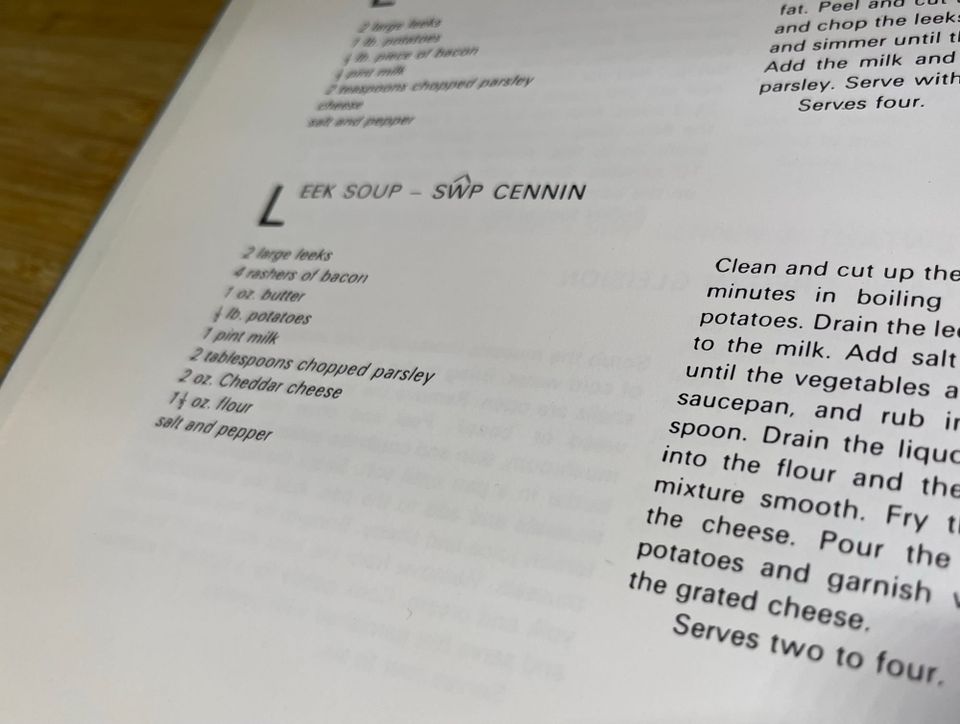
This potatoey recipe is not directly ancestral, nor have my owner and I made it more than a few times so far, but it comes from a wonderfully dilapidated cookbook of Cymric recipes in general, which I inherited at some point and which has been slowly growing my knowledge of Cymric cuisine. My owner and I have also slightly modified the recipe ourselves. I will also have some non-recipe thoughts afterward.
Potato leek soup
Even though we're nowhere near the autumn potato harvest or soup weather, I was thinking about this recipe because of how at some hardiness zones there can already be a plentiful leek harvest right now, and we're supposedly coming up on leek season in my own zone. So if you do want a warm supper despite the summer and you have fresh leeks available, this could still work hit the spot even if your potatoes are not so fresh.
Ingredients:
2 large leeks
1/2 lb. potatoes (gold are best, but anything waxy with low to medium starch might work, just not high-starch types like russets)
1 pint milk (my household typically uses whole cow milk, but we've successfully substituted oat milk)
1 oz. butter (we use salted butter over unsalted, every time, everywhere)
1 1/2 oz. flour
2 tbsp. chopped parsley
salt & pepper
Necessary garnish: well-aged Cheddar cheese (see recommendations in footnote)[1]
Optional garnish: bacon
Steps:
- Clean and cut up leeks. If you’ve never cooked with leeks, use the white part up through where the green leaves start to split or if things feel “woody” under the knife. Boil in a pot for a few minutes with salted water until leeks are slightly softened, then drain.
- Peel and cut up potatoes. Add them and the leeks back into the pot, then pour in milk. Bring back to gentle boil.
- Add salt and pepper to taste and leave boiling until potatoes are tender.
- Grate cheese and (if desired) fry bacon so that garnish(es) will be ready.
- Use butter and flour to make a roux in a separate pot or high-walled pan.
- Drain leek/potato/milk mix into colander, with a bowl underneath it to catch the liquid.
- Stir the liquid portion into the roux. Keep smooth. Add parsley.
- Add boiled leeks and potatoes to the roux/milk mix. Make sure the soup is well incorporated, then serve with garnishes.
When I eat this soup
When I eat this soup, I think of many things, ingredient by ingredient.
The leek is an odd little nationalist symbol of Cymru. I say "odd" because leeks aren't a terribly glamorous vegetable, and because Cymru has always worn any nationalism in a strange way. People there have fought on and off for liberation from English hegemony over many centuries, but it's long been more of a haphazard thing than the independence movements of cousin cultures nearby. Revolutionary violence in Cymru is relatively rare, and legislative measures toward an independence referendum have only barely started to pick up any momentum as the UK finally enters an accelerated decline. I could join cynics in saying that typically my Cymric ancestors and kin are indeed full of stereotypical hot air, talking a lot about autonomy and sovereignty without usually trying to do much about it; if nothing else, before the Irish were whitened over here in the US, a lot of Cymric whitening and collaborationism with Anglo-identity had already taken place. But something I do like about Cymric nationalist history is that when it's cropped up within the last century or two, in my awareness it's not usually nationalist as some separatist, exclusionary vehicle. Instead it's often informed by a left-wing, socialist workers' ethos with the spirit of internationalism and cooperation. This doesn't come without its own flaws, but it's better than a lot of alternatives. I think the leek might be an apt way to picture how to distinguish ourselves from Anglo-whiteness without seeking some alternate form of cultural superiority.
The potato is the potato. I've said plenty about potatoes before. But one thing I haven't said too much about yet is the apparent tug of war between the potato and the person who plants it. Despite how long the potato has been domesticated, the plant does not yield its tubers without a poisonous game. All parts of the plant besides the tuber contain solanine, the hallmark of most toxic nightshades; and even when the tubers are made, they grow on stolons that the plant emits very shallowly beneath the soil surface, sometimes even above it. If a tuber is exposed to sunlight, solanine production within it will skyrocket and the tuber will show that green hue we're all warned not to eat. In truth, since exact solanine content varies from plant to plant, eating a green potato may not cause more problems than making somebody rather sick, but by the same token it's not worth fucking around to find out. So just like potatoes' solanine-packed fruits — which look somewhere between a tomato and an eggplant — it's clear that the plant is happy to render up parts of itself through cultivation, but it doesn't much care if you die in the process of eating it. So thank you, potato... but I have my eye on you, no pun intended.
The milk is mammalian connection. The butter, too. And the cheese. I think of mothers. When I eat these in the soup I think of my mother, and her mother, and many mothers who came before, waking and walking and working in the southern valleys of a homeland my bones still remember, and then at some point the first mother who came to one of those valleys from somewhere else, somewhere I do not know, but a piece of it is carried with me forever.
The flour, with its gluten, is the binding agent. From flour we might also make bread, or beer, which are binding agents for human beings.
The parsley is part of ancestral folk medicine, purported to relieve that which is blocked, whether it be gas, urine, milk, or menses. Whatever the truth of that is, I suppose it must at least apply to the last thing; parsley leaves are safe to eat in small quantities during a desired pregnancy, but large quantities have been identified scientifically as a means of causing uterine contractions, much like misoprostol. I do not know for certain, but I wonder if this mechanism is the same thing underpinning why people regard wild carrot ("Queen Anne's lace") as an abortifacient, since it's a rather close relative to parsley.
The salt is life, and the sea. I come from people who lived not only in the mountain valleys but also by the sea, which could render abundant food in the form of not only fish but also molluscs and seaweed. Cymru is one of the main places in Eurasia besides Japan or Korea where Porphyra seaweed forms a key part of the traditional diet.
The pepper is spice and beauty. Despite how boring and trite a shaker of pre-ground pepper can be, I consider the flavor of freshly ground pepper almost sacred. As fanatical as some people become about putting lots of garlic in any dish that calls for a measly little clove — and trust me, I'm one of those people as well — I can't stand when pepper is treated as a mere afterthought. It's a flavor unto itself, and it has a role to play in traditional cuisines across an entire continent or two. Use it!
And when bacon is used, I am of course very grateful to the pig. But even when there is no bacon, I am grateful to the plants and other animals who played their own role in the soup.
And I am grateful to the people who sent the recipe for the soup into my hands, and to the person whom I help to make the soup from time to time.
And I am now grateful most of all for the child whom I will teach about the soup one day.
[1] Not all Cheddars are created equal, not even well-aged ones. Absolutely any aged Cheddar will do in a pinch, but if you're okay with buying an imported cheese, I strongly advise using an actual Cymric (i.e. Welsh) Cheddar; Collier's is a brand I will endorse for this purpose. It's an utterly phenomenal cheese. If you can't find it Stateside, a more widely available Irish option is Kerrygold; I'd recommend their Dubliner variety. Of course, if you're a stickler for Cheddar from its actual native Somerset, that's also probably a good choice.
Thank you for reading. I know that my posts have been a little short and/or lightweight lately, but this post was truly just the length it needed to be, and I hope I'll have a lot more I can write over these remaining weeks of summer — before that impending ancestorhood throws my schedule into temporary oblivion. I will try and provide a special update before September about what to expect (or not) of any new publishing strategy here.
In any case, next Friday there will be a post for paid subscribers on summer constellations, and the week afterward I will be offering some thoughts on a tricky but vital dimension to what I call "the settler's dilemma" in decolonial activism.
Member discussion