First Quarter: Birch
Hello. It's Friday, and for several days I've been overwhelmed by tree pollen. Despite having allergies and sensitivities for most of my life, the problem of "spring allergies" is relatively new for me, with my first memory of them starting after my severe GI illness of 2018; perhaps the decimation of my gut flora had immune effects beyond the overall inflammatory problems I initially discovered. I'll never really know, but since I already grew up suffering from a ragweed allergy, I certainly haven't appreciated how for certain stretches of both autumn and spring I now need to live on antihistamines. And with each year, I seem to have an even stronger response, but I may also never learn whether this is a quirk of my own body or an unfortunate reality of the ecological crisis as thick pollen production increases with rising temperatures.
This year I seem to be having a particularly difficult time, for which I will blame certain extenuating hormonal conditions. But as I continue to navigate this annual inconvenience during what's otherwise a perfect time of year for existing outdoors, I know I might appreciate having some testing done to figure out which spring allergen is my culprit. I'm fairly certain it's a tree, not grass, but beyond that I can't tell; if I could identify the specific pollen-emitter, though, I could more strategically manage my exposure.
And I do hope the problem isn't birch pollen, because birch is one of the most sacred and beautiful trees in my cosmology. Of course, it wouldn't be the first instance of a sacred tree causing negative health effects for somebody. But it seems ironic that I may be suffering from the birch right now in a week when I had previously planned to write an ode to it.
Well, I will try to write one nonetheless. No hard feelings.
Ancestors (I)
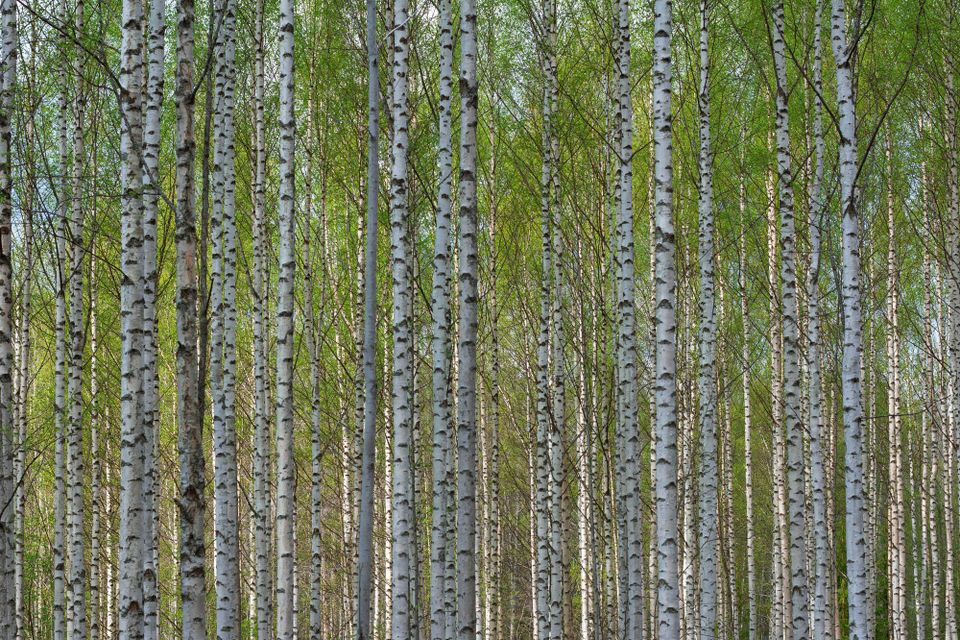
I am descended from peoples who lived where the silver birch grows. Betula pendula. Sometimes this is also named the white birch, but because there are also white-colored birches in other places, I find the more romantic-sounding "silver" appropriate. On a bus in Russia twenty years ago, I rode past vast forests of silver birch, and their slender shapes looked like glowing ghosts.
The range of the silver birch extends further south than the great circumpolar boreal forest — also known as the taiga — but it shares much of the same territory and is bound up with the cycles of ice and fire that fuel the planet's largest land biome. Periodically, wildfire raises the forest and the first trees to return are what ecologists call pioneer species, the ones that grow easily in disturbed earth under open sunlight. Betula is one such genus; no birch lives terribly long, since it will be outcompeted by taller trees that shadow it over time, but across circumpolar landscapes there are still those endless acres of birches spreading with the careless exuberance of youth, wherever older trees once stood or wherever other trees have not yet ventured.
From the silver birch my ancestors would have known various gifts. Birch sap takes more effort to transform into a sweetener than sugar maple sap, but it can be done, and because Eurasian maple species' sap is not as optimized as the sugar maple's it has come to pass that birch-based syrups and beverages are a marker of formerly-indigenous European lifeways. Meanwhile, the wood has versatile uses in carpentry and carving; and the bark and leaves were and sometimes still are used in folk medicine, along with the fungi that the birch typically hosts, such as birch polypore and chaga. The former will infest and kill a birch over time, but it's not toxic to humans and it may be used for instance as an antiparasitic.[1] As for the chaga, this too will kill its host, but it takes a little longer, and it can be brewed into a nutrient-packed coffee-like drink as well as kept around as a tinder fungus, easily ignited when dry or wet. Birch bark itself is also an excellent tinder, and the resin has been used for some of the oldest forms of tar (pitch) ever created. In traditional sauna culture, birch branches and leaves are used to flog the skin, opening up the pores and letting in the heat of the steam.
Perhaps birch carries the energy of wildfire within. Either way, to me the silver birch feels like one of the most potent, prominent ancestor-trees for people with northern Eurasian backgrounds, extending all the way from Connemara to Chukotka. The tree has been integrated into so many parts of human life over the millennia that it must have helped to raise some children in its own manner. Like other species who live in kinship with us, it has been a more-than-human parent.
Ancestors (II)
In cultures that erect maypoles, birch is often the chosen tree.
Besides this, in Germanic animism birch is one of the two trees with a clear runic alphabet assignment: ᛒ (beorc to the Old English, bjarkan to the Norse). The Old English rune poem uses this kenning for it:
Birch has no fruit, yet it bears nevertheless
shoots without fruits, is beautiful with branches
high in its crown, splendidly adorned
and laden with leaves, pressing up loftily
In my study of the runes, I have tended to find a feminine association for ᛒ. Is it because the tree looks delicate and pretty? Perhaps, but there is not only a youthful, maiden-like flavor of femininity here; because birches are so flexible and also represent the forest's resilience after fire, they also present a model of strength and power that is more nuanced than warlike machismo. And on the one hand a birch might thus be connected to fertility, but I read something crone-like or even queer in birch has no fruit, yet it bears nevertheless.
My Celtic ancestors certainly revered the birch in their own ways, too. Like the apple and the hawthorn, the birch is Otherworldly, perhaps on the basis of its strange beauty and tendency to repopulate after destruction. But its particular magic was not to be feared; in Cymru its wood was and remains appropriate for a love spoon, or for a baby's cradle, and the leaves or twigs might be bundled into a ward. It is a protective wood, even used for brooms to sweep away bad things. For the Irish, cousins to my ancestors, Beith is the first letter of the Ogham alphabet, represented as ᚁ, and the associated tree is birch — the names are indeed the same — and writings on Beith declare it a guard against being carried off into the fey realm.
Here
There are several birch species that grow in the corner of Turtle Island where I live, chiefly paper birch (Betula papyrifera), grey birch (Betula populifolia), black birch (Betula nigra), and yellow birch (Betula alleghaniensis). These, too, are hosts to the birch polypore fungus and the chaga, called shkitagen in Potawatomi.[2]
The paper birch looks most similar to the silver birch of my ancestors, and perhaps not by coincidence its native range likewise overlaps with this continent's portion of the great boreal forest; this tree's bark has also earned it the name "canoe birch" because of indigenous birch bark canoes (maskwaiolagw is "a canoe" in the local Abenaki language, related to maskwamozi "birch").
The grey birch is a pioneer species like the others above, but its range is much smaller, covering only a couple of ecoregions here in the Northeast. Its bark does not peel as easily, and it earns its name due to having many darker streaks that create a greyish tint. Because of its poplar-like leaves, it can be confused with quaking aspen.
The black birch is so called because it has none of the iconic, high-contrast bark; this instead looks salmon-colored in youth and darkens to grey-brown with age. The peeling also happens vertically. I think the tree looks a lot like shagbark hickory, except for appearing more delicate and of course not producing nuts in the autumn.
I like all of these birches and am especially partial to the paper birch, but if you were to visit my particular neighborhood, you might only see a few papers, and neither of the others. The birch that truly reigns right here is the yellow birch, which is so prevalent that its own bark has also been used for canoes. When I first moved to this area, I didn't know I was looking at a birch at all, thinking it might instead be hazel, but again — no nuts. The bark nonetheless has that hue of yellow-green-brown. The wood is frequently harvested for lumber. People also call this tree the swamp birch because it favors growing on stream banks, and I find it apt because the brook that runs near this house is lined with many such birches.
There is one very large, old yellow birch by the brook, in whom I have come to sense a spirit. This is the Mother Yellow Birch. I don't know yet if she's simply the mother of all the yellow birches in the vicinity, or if she holds a wider maternal role in this landscape, but motherhood hangs upon her. When I visit her, I touch her bark carefully and I try to picture the sap flowing through her, carrying sugar between leaf and root. Sometimes I can almost feel it. She does not look like the strongest tree in these woods, but her power still feels immeasurable. I have asked her for guidance and support many times in my (in)fertility saga, and she has answered me in many ways, although I'm still figuring out how to interpret them. The answer is always a feeling beyond words.
For those of us who live as settlers, I find it important to build strong relationships with circumpolar species, like the raven and red fox, or with genuses featuring circumpolar cousins, like the birches. These beings can keep us in touch both with where we came from and where we are now. They are paths to naturalization and creolization.
In the bedroom where I sleep with my owner, one of the first things we did upon moving in was paint white birches on the wall. Silver, paper, or both.
[1] Birch polypore specimens were found preserved in the belongings of the mummified Ötzi in the Alps, which would align with the gastrointestinal upset that researchers speculate he was fighting (alongside arthritis) at the time of his death.
[2] This name is in fact the first one that I learned for the fungus, thanks to Robin Wall Kimmerer's Braiding Sweetgrass.
Thank you for reading. I hope this ode to my possible allergenic assailant has placated it a little. Next week, I'm going to evaluate not just one form of divination but the entire field thereof, digging down into the what and why of it, likely as a companion piece to my essay on spellcraft. The following week, death work returns as I reflect on the existence (or not) of an afterlife.

Member discussion