First Quarter: Hail to the basket weavers
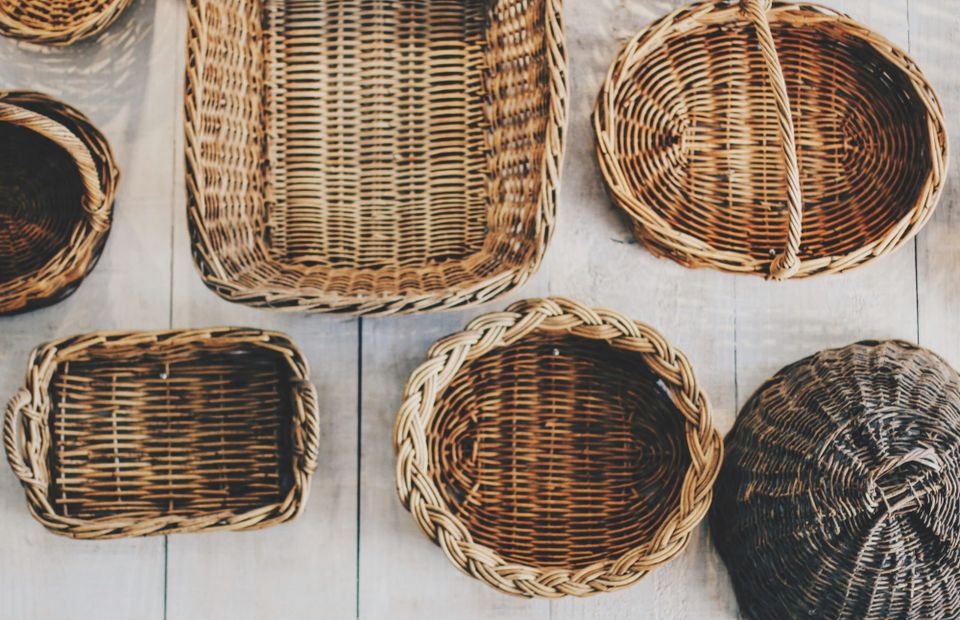
Hello. It's Friday, and because I slept extremely poorly last night, I was tempted to skip posting this week; but I just skipped so recently that I would rather not, especially when I'm probably at best a month away from my normal posting schedule getting thrown into a disarray that I can't figure out how to solve until I'm already living with the chaos.
Nonetheless, I should be honest that you should expect a snippet, and because of the paths my reshaping mind is walking it will be a rather abstruse one at that, despite the shared theme with earlier posts: saluting particular keepers of old hand crafts.
A myth of useless ephemera
In critiquing a particular intensity of liberal arts education, sometimes the expression "underwater basket weaving classes" gets thrown around, and this choice of words may be meant to convey pointlessness insofar as weaving baskets underwater would be rather impractical for an air-breathing human to attempt over weaving the baskets on land — or perhaps there is also the sense that baskets used underwater may function poorly because the water's currents would very easily upend a basket or buoy its contents up and away. I have never really been clear on exactly how the phrase came into existence.
But to some extent "underwater basket weaving classes" sounds redundant when I have also heard phrases like "taking up basket weaving" — any basket weaving, not just underwater — to connote a very similar kind of activity where someone acquires a skill more for some crunchy, soothingly New Age aesthetic around inner peace and less for the skill presenting any practical value. Not coincidentally, I'm certain that I hear any basket weaving adoption attributed most often to women; and though not universally classified as "women's work" across all cultures, basket weaving at least has a fairly strong history like fiber arts as "women's work" in the cultures that were warped and diluted into Euro-colonial modernity. Indeed, basket weaving is very close to fiber arts in the creative and structural principles that it relies on, with the key distinction maybe only being stiffer materials. Even if we could divide the crafts further from each other, though, basket weaving's contextual history as women's work seems to have resulted at some point in a recent cultural belief that if you really go to the effort of weaving a basket you are at most making an art piece. It is a frivolous hand-stimulation. Nobody needs baskets anymore.
A very strange attitude, of course, if you regularly use things like laundry hampers and smaller baskets for garden work. But all of that also does say "woman" to many people, and it's based on ongoing patriarchal realities.
The deeper strangeness arises when considering how, like fiber arts again, basket weaving is almost certainly one of the oldest crafts that humans have ever practiced. But then again, just like textiles, the material of baskets will disintegrate and decompose quickly enough on the geologic time scale that we may never know exactly when the first baskets were woven.
So baskets are not really useless, but their usefulness is easy to overlook if someone perpetually devalues the people perceived as inherent basket makers. And baskets are not really ephemeral as a craft, but they are certainly ephemeral as specimens.
Carrier
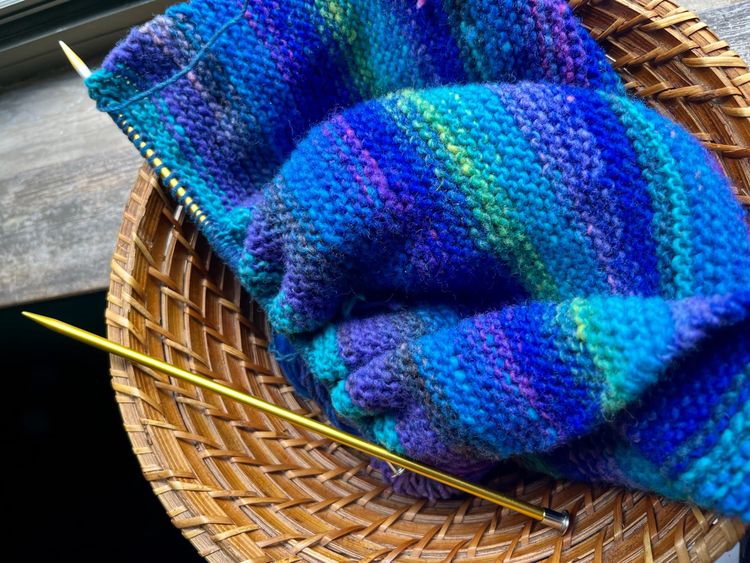
I do have experience these days with fiber arts. I do not have experience yet with weaving baskets. But I've had quite a few experiences with turning myself into something like a basket.
Container. Receptacle. Carrier.
Bread basket. Bred basket.
Bread comes from wheat. I have at least woven a little wheat. Corn dollies.
The Empress sits in a wheat field.
Nesting instinct
It is also incorrect to say that we don't have examples of the oldest baskets. We do; they simply were not made by humans. The basket is so old that it was in all likelihood invented by cup-nesting birds.
For several years now, the scotch pine bush that grows in front of our dining room window has become the chosen site for a few different birds to build nests. One year there was a robin's nest, and the bush seem to be a repeat site for chipping sparrows. Maybe others. The cats naturally love to catch a glimpse of baby birds screaming for food after they hatch, and I do love to see that myself. But I also love to watch the process leading up to the babies: one or two birds carrying twig after tiny twig, pine needle after pine needle, fluff after fluff, to their chosen base. The nest itself is always made so stealthily that I never quite get to view the technique. How does the shape hold together with the strength to support several small animals in it at once, while remaining utterly delicate and so lightweight that perhaps a fierce breeze could blow it away?
I imagine these birds must need some understanding of physical principles like reversing tension. Could they linguistically explain that? They have a communication system that especially in songbirds does merit the term "language" or at least "proto-language." Do they think with it? Is it the substrate of their cognition? Or do they just know how to weave their nests according to some inherited muscle memory, something in the cerebellum?
To ask questions with such framings can also suggest that thinking linguistically, or being able to explain one's thoughts in language and thus teach through language, is a superior form of thinking and teaching to what muscle memory allows for.
"Are all things done best through words?" she asks, writing.
Thank you for reading and — as I keep saying — your patience during this very unusual chapter of my existence.
Next week, I will hopefully manage a long-intended post on reactionary usage of Germanic animist symbols, but because that Friday is also the start of my new bimonthly volunteering gig I am not yet sure if I'll wind up posting earlier or later in the day than usual (or for that matter on Saturday). The following week, I should have less interference but the post will be only for Occult-tier subscribers.


Member discussion