First Quarter: To be a weaver
It's Friday. Hello.
I am run ragged this week. It's a shock I drew these words out of myself. Nonetheless there's that compulsion to draw them. I am baffled by people who claim to enjoy writing yet who also claim to prefer the convenience or novelty of a fraudulently marketed, entirely plagiarized, dangerously misinformative, water-guzzling, carbon-blasting, psychosis-inducing option of a digital program spitting out some text that resembles what it might give anybody else who prompted it with exactly the same terms. Even leaving aside the many, many ethical and pragmatic issues in play, I will observe what countless others in my position have observed: these people evidently do not like writing so much as they like having the end product of a thing that was written. Now that they have a cursed object that costs less than paying someone else to write, they have what they need.
I need the process of writing as much as the end result. If the words do not come out of me, then whatever gets expressed is not really my expression. When I write I extrude some of myself, leaving traces of my person on the rest of the universe, connecting and binding and weaving.
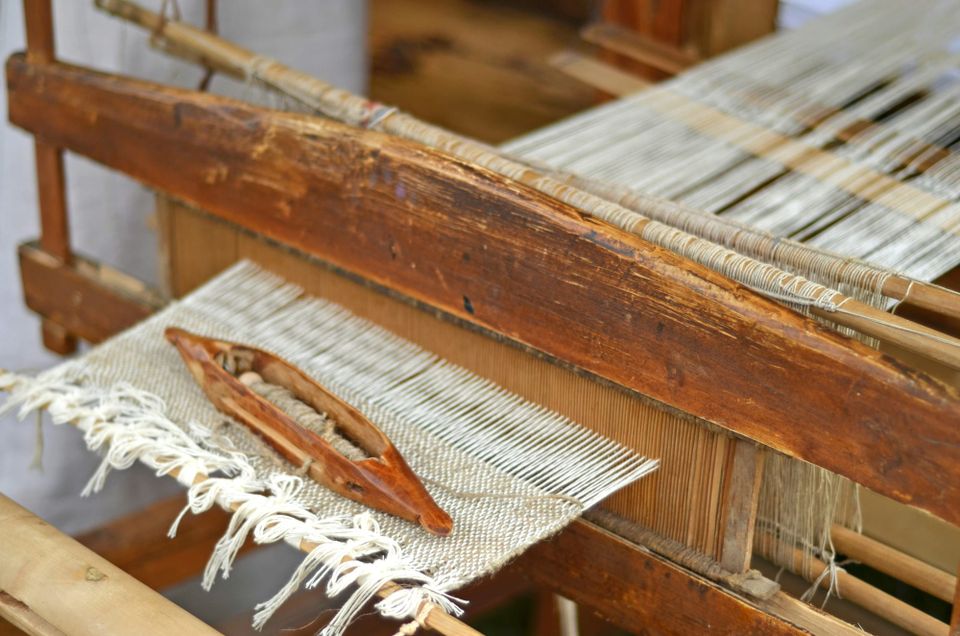
It's no accident that writing is often compared to weaving. Words and fabric are both the material of storytelling, right down to the shared etymology of text and textile. It's also no accident that the digital programs lobbed at us to automate everything are particularly targeted toward the textual media that forms the essence of their own architecture. And it's a strange cycle we're in now, as the catastrophe of industrialization began with automating the art of weaving, and that automation itself gave birth to computers.
Join me tonight on a walk through the tapestries of history.
Text(ile)
Story is creation. Words invent places and times and beings. Weaving and its cousin-arts make two- and even three-dimensional objects from one-dimensional fibers. All is telling.
The narrative of someone's life is measured mythically in thread. The best tales are described as yarns. And when we write words down, we give their power flesh. A book is a kind of fabric.
All these things we make most by night, or in winter, or both. Winter nights. Darkness stretching longest means fire burning longest, and the fire is the gathering place, and the gathering place is where we talk and tell. The gathering place is also where we sit in warm shelter, circled round, weaving and spinning. And still talking, still telling.
A part of me is always sitting by that fire, a hearth belonging to one ancestor or another, listening to the bard, or perhaps I am the bard. Weaving on my loom, pass after pass, hour after hour, the wool threads soft and colorful between my fingers.
Nothing made this women's work; indeed, beyond patriarchal constraint there was (is) many a culture where men weave, and within that constraint it was (is) the rule that men be the storytellers, most of all in writing, all women's words silenced or derided. But within that same constraint it did become a fact and expectation that women weave, for the task's repetitive nature made it drudgery to any mind that fancied itself better suited for lofty things.
As has often happened, women took the work allotted to them and resisted by making the work sacred. They (we) nurtured a knowledge base that for millennia never needed writing, sometimes not even speaking. Beyond oral tradition — tactile tradition. The fibercrafting together, the circles for it, these were sanctuaries, with all stories told around those fires, even the ones that couldn't be uttered elsewhere.
The killing shuttle
Early capital could not abide anything a woman did that wasn't domestic; she was to breed and rear and clean and cook and make textiles so that her husband could sell his labor and her children could sell their labor next. She could earn pay for her household if it were poor enough, but it must still come through that domestic kind of work.
So things went for a little while as the merchants and aristocrats merged to form the bosses, as land was stolen and resources bled more than any previous empire had yet achieved. Women endured this latest subjugation, and then of course they (we) had too much pride, too much power over that which was allotted to them (us).
It was time to innovate. It was time to take away some of the work that women could even have, and to make sure that the women who still performed it could be far more tightly controlled. And in the remaining cases of men who also weaved or practiced other fiber arts — for there were plenty — surely they might be grateful to be relieved of the drudgery. They couldn't have really enjoyed it.
The flying shuttle was the killing shuttle. Its blindingly swift movement caused innumerable deaths and injuries by mechanical loom operators, but as the harbinger of industrialization it also was meant to kill independent livelihoods — a freedom that had emerged from the Black Death's disruption of serfdom but was intolerable to the first bosses.
Resistance did come again. There were the Luddites, much misunderstood, and others like them, smashing the machines not because they were wholly evil but because they were not equitably introduced. I do wish to ask if the failure to equitably introduce the machines does taint them with evil; the failing cannot be undone, poisoning the root of that timeline. Alternately, I wish to ask if such machines ever could have been equitably introduced. Automation may benefit some workers in the short term under the right arrangement, but it doesn't benefit anyone in the long term if it demands extractive economics, the polluting of earth, air, and water, and the wholesale extinction of biospheres.
Irony did also come. Women flocked to the textile mills and often earned much better wages than they would have otherwise managed, as well as having lives outside the home if they desired (or needed). This balance itself was offset by unsafe working conditions and severe employer control over every waking hour; but the garment industry was then one of the most significant to unionize. The flying shuttle did kill, but what rose from the ashes had incredible power again.
Punch-card fever
As mechanical loom designs evolved, eventually they were programmed to require even less oversight in order to produce certain results. Joseph Marie Jacquard iterated upon pre-industrial French punch-card guidance for human-operated looms, integrating the punch-card method with industrial loom automation.
Over the ensuing decades of the 19th century into the 20th, various other people dared to wonder what other sorts of information might be conveyed through punch-cards and the right machine to read them. Perhaps the most miraculous machine could process, store, and render any information at all, rather like an brain though without sensory embodiment.
Eventually these computers were made, originally for the purpose of mathematical operations that a category of human worker once known as a "computer" might perform. Most human computers were women. As digital computers proliferated and were rapidly anthropomorphized by their users, more often than not these computers were also named, identified, and spoken to as if they were women. Programming the computers was also seen as drudgery, so this too was given to women.
At some point this became unacceptable because there was actually a lot of profit to be found in computer programming.
Women's new work
We know the rest, don't we. Now the computer is touted as a replacement for weaving's sibling writing, and writing has lately been the provenance of women, at least in supposedly frivolous areas like fiction or genuinely frivolous areas like advertising copy. The computer can (even should!) be a replacement for domestic workers and their knowledge base, whether as a robot that vacuums or as a magical recipe generator. And we can replace emotional support, sexual fulfillment — the list goes on. Why have women anymore?
Why have weaving?
Why have stories?
Away with them all, let consensus reality collapse, let the fabric unravel, let the stories burn. Fuck the Fates, declare the builders of the god-machine, except that they mean not to fuck the Fates at all, having been rejected by them over that inexplicable misunderstanding about when it's rational to send dick pictures.
This is what we face. But I do laugh. I laugh at these people who think they've made something intelligent or animate in anything other than the most corrupt sense imaginable. For those of us they would deny the chance to weave, to write, to tell, to create, we are all womaned by them, whether or not they know us as women, whether or not we are women; there is a different work before us now, but it is also always the same.
Take what they deride and make it sacred.
Bless the old loom, and the old stylus, and the work of our hands, and the words of our mouths. Bless what we make in the circle around the fire.
That fire simply needs to be kindled anew.
Thank you for reading. I wanted to write something along these lines for ages — especially since I paid a visit the other year to the Boott Cotton Mill museum in Lowell, Massachusetts. If you want to be somatically inundated with the weight of everything I've just described, go there to see a demonstration of a 19th century mechanical loom hall in action.
Next week I will more likely wind up with a Saturday post due to complex long weekend scheduling, but it should be a post for paid subscribers wrapping up my theory of divination. After that, I'll have another paid post asking the question of whether all kinks are really "okay" and why we tend to ask that question instead of asking whether we ourselves are "okay."

Member discussion