Solar Autumn + Full Moon: Fertility reexamined
It's Friday, and on this particular Friday I have been married for fifteen years, and tomorrow comes the holiday that my owner and I mark as Calan Awst, but which many of you may call Lughnasadh or Lammas. As the observance of the grain harvest and a celebration of other first fruits, it is a day in which fertility rites naturally come to the fore, but less as a matter of hope and sacrifice like we witness in the spring or summer, and more a matter of thanksgiving for what the earth has gifted us — and of reckoning how much we can now carry with us into the ever-looming darker half of the year. What was sown shall be reaped, and we honor it.
Because of what I have endeavored to reap from my own womb for more than a decade, and because of how near I draw to that moment, I think now is an important time for me to take stock of what I have bodily endured, paying respect to the agonies of earlier attempts but acknowledging that mostly I no longer ought to grapple with the spectre of barrenness; I am instead awakening to the equal challenge of living as two-in-one beings. First in that most uncanny mammalian way, then whenever I release my burden into the wider world and remain forever responsible-yet-not for its own life and doings.
Since — as I have already warned readers a few times — this process lately been reshaping my very mind and thus for at least a little while I find my writing is strongest in a fully creative rather than analytical mode, the meditations I offer today are not strung together in a deliberate order, and various ideas may present themselves through vignettes. There is not one central thesis.
My words are an untranslated transmission of what stands on the threshold of the veil.
A content warning applies throughout this piece for clinical infertility, miscarriage, pregnancy termination, forced birth, right-wing/patriarchal pronatalism, and everything remotely in that realm.
Fertility/ecstasy, again
The cosmic opposition is not of good and evil, nor of dark and light, nor of sexes or genders, but of making and unmaking, creation-destruction. As I have before, I call this the fertile and the ecstatic. One pole generates and the other consumes. One gives of itself and the other receives unto itself. To do fertility work we produce, offer, pour our essences into other things; to do ecstasy work we transcend, transmute, become what we take in. Balancing the poles is vital, because endless growth without death results in depleted resources, while endless indulgence without output results in a static environment, and in either case entropy reigns.
Each pole is contained within the other even more than the ritualist might imagine. Accessing fertile energies may require ecstatic practices, while ecstatic experience may be attained through fertile activity; yet going further, distinguishing between one pole or the other may be a matter of context or perspective rather than of any singular, absolute qualities. This does not mean the dichotomy is an illusion. It means that when we noticing the opposing forces in one thing together, we are witnessing the outcome of their eternal game.
For so very long, I saw myself with an imbalance. I followed rites belonging to either pole or somewhere in between, but the ecstatic work always seemed easier to undertake and I always seemed able to pursue it to a further conclusion.
This could be seen in how I was so embedded in kink and starting to pursue psychedelic work or other altered states, rarely submerging myself at the level of ordeal but knowing exactly how to arrange for that if I wished. Pain for its own sake is on the surface an ecstatic rite, and quintessentially so. Likewise a journey through the Otherworldly. The path to doing magic this way laid itself out before me without much struggle on my part. It went the same for worshiping a singular trickster god, indeed engaging chiefly with the trickster quality itself, the destroyer, the monster. It went the same as well for constructing synthetic, individually unique practices selfishly for me, as compared with accessing embedded, communal, culturally specific practices that I could not invent so much as inherit. And it went the same for building a deliberate relationship with death, and preparing for apocalypse.
The things I framed as fertility work did not go this way. And after all, living when I do, as the sort of person raised how I was, why would it? Art is a kind of fertility practice, but prioritizing it under capitalism generally invites poverty rather than abundance. Divination — fertility work insofar as the reader becomes a conduit for something other than themselves — is valuable to me, but I have yet to perform many readings that are not in service of my own ego and anxieties. I struggle to overcome scheduling or sensory obstacles to building a relationship with the land around me, despite the many strides I have made over the past few years. I call myself an animist but I can neither name nor recognize all the gods or spirits I perhaps ought to know. I try to uphold some things my ancestors would have done, but so much is wreathed in old smoke, hidden and lost, that I worry about engaging in useless charades. I live in an orphaned society, and upon a planet whose systems are dying. How could fertility rites work as they should for me?
And why would my bodily fertility not be stymied?
It was. It has been. In the far past it would not have been strange at all for me to start motherhood twice in blood and loss before carrying a third child to term, particularly at this age, but I should not have felt obliged to wait so long to conceive unless I truly wished to wait. And now I had waited long enough that I might have turned sterile faster than I could prove otherwise. Even for my age I've shown markers of fertility that's diminished prematurely in certain ways — perhaps a consequence of a physical condition that in a different, less patriarchal medical system might be better understood, or perhaps a consequence of modern diet, modern pollution, modern stress. The threat of extinction on the grand scale — the threat of barrenness on the map of my flesh.
Yet it was only a threat, or so it seems. These things are always on a continuum; I will always maintain that I became a mother the very first time I became pregnant, and I have thus had three children. Two simply did not leave my body alive. Nevertheless, it is of course different to give birth to something alive. It is different to have one's body fully matresce, just as speaking from trans experience there is a distinction between being socially recognized as (gender) versus having one's body go through physical development toward a particular phenotype. It is also different to watch the infant that came from one's body grow up and become a unique, independent person. My deep fear and grief of these past years could naturally not have been assuaged by the knowledge that I "was" a mother despite my losses. A mother, yes, but one who had been robbed of a primordial transformation and of years caring for the child she desired. So as I grow closer to achieving what had been lost twice before, the old threat starts retreating from my mind.
I find myself rebalancing. I am faced with a profound opportunity to do fertility work in my witchcraft as I never could before; I am indeed doing that work in my body, but I also feel myself more in tune with something ineffable that is needed for art, divination, animism, land connection, ancestor connection. It makes sense. I am now so thirsty to act as conduit, vessel, channel, container: matrix.
But peculiarly, and not peculiarly at all, there has been more ecstatic work in this great process than I could ever have foreseen. I am in nine months of ordeal, though it has treated me more gently than it treats some. As labor inexorably approaches, I gird myself for pain that will be as violent as it is beautiful; I hope I have honed the skills to embrace the pain, but if the pain crosses the line into true suffering then I will have much to learn. I think over and over again of what the mushrooms once showed me, and I wonder if that will be enough to carry me. This too shall pass, so they say. Passion. Mary, crucified.
I am having to remember myself, no matter how long I have dreamed of containing more than myself. I am grateful when others notice that my bodily changes are as important as the baby that will leave my body.
One child of three
Child of the equinox, for thus you are anticipated, a strange gift to arrive when we enter the dark half of the year: will you prefer to walk in light, or in shadows, or both?
Child of the marigolds, for these should bloom when you arrive: what will I say to you of the two who came before you? When will I tell you about them? When will you be ready to know? Will the story frighten you? Will it break my heart to utter it, or will it heal me?
Rule of threes:
The one who made me learn how to mourn a child long hoped-for.
The one who made me learn how to kill a child no matter how hoped-for.
The one who stays.
Will you outlive me? This is how we all think it should go. It would be the simplest story and the most comforting. But sometimes I do sit and wonder if you will grow to adulthood at all, and if you will have any children of your own — if you do have any, of course I hope only by your intention. Only you can decide whether you should become an ancestor like me. What if you did not live long enough to make such choices, however?
Would it be enough in my heart and spirit and body to know that I had finally been a mother in the full way I dreamed, even if it still wasn't for very long? Or would it not be enough? What could ever be enough?
Death in reverse
When somebody dies, first they stop eating, then they stop making sound, then they stop breathing. Their organs and tissues then turn into simpler chemical compounds that are consumed by other beings. As they are deconstituted, the possessions and objects that they needed in life slowly disappear from the dwelling they inhabited, sent to family or sold to strangers. As months and eventually years pass, people talk about the idea of them even though they are not present. But then there comes a point where nobody remains who could ever fathom that this specific person ever existed, and this persists for the entire future of the universe.
When somebody is born, first the entire past of the universe has been spent with nobody ever fathoming that this specific person ever might exist, until suddenly people talk about the idea of them and start collecting objects for them. Meanwhile, they are made a reality from simpler chemical compounds that are drawn from the nutrients inside another being, eventually forming organs and tissues. One day they draw their first breath, and they make their first sound, and at some point they start to eat.
My body felt like a grave for fourteen months, and now I imagine I should say it feels like the opposite of a grave, but is there really an opposite? The womb is the tomb. The womb is the tomb. The womb is the tomb. What goes in always comes out as something else.
The confusion runs deep enough that I do not need to have been raised with taboos for pregnant people in order to feel certain instincts rise in my own body. I am dwelling close to death, close to the open veil, and so is the child. And we are too close to safely enter a cemetery at the wrong hour or under the Full Moon's light; we are too close to let me walk through the place of power on the side of the road near my house; we are too close for me to engage in certain kinds of death work. In having to withdraw from our next eclipse pilgrimage for unrelated reasons, I find myself still upset but also oddly relieved, because I nearly understand why some traditional prohibitions would bid me hide from an eclipse. With the portal open in my belly, pointing myself too long in one direction might give this child the wrong impression of where to travel. Or perhaps I might grow confused and fall into the chthonic dark as if Orpheus had looked back at me, only I had looked back at myself.
Parasite
People who do not want to carry children are perfectly justified in calling them parasites. Meanwhile the patriarchs, the forced-birthers, the quiverfulls, they wrongly pretend that they can look away from anything in pregnancy that is too corporeal, too visceral, too wet; to them such imagery belongs only in propaganda about how hideous abortion is, as if our bodies do not spontaneously abort all the time. But pregnancy is very material, as I grasp more by the very day.
It is meat, it is fat, it is wet, it is round, it is swollen, it is obscene. Strange shuddering twitches. Squelching noises. Blood, piss, shit, and all the moreso during the birth I still await. The process of composition would probably look as horrific as decomposition if we could ever watch it. During the first ultrasounds, when this child's skin was still translucent, I grew morbidly enamoured with the details of their skeleton. From their first quickening to their more sophisticated movements here at 32 weeks, I have been unable to stop picturing them as some only half-thinking, half-aware mechanism, jittering and spasming through random electrical impulses. And because I've happened to be someone whose body so far has only gained half a dozen pounds throughout the pregnancy — not even all the pounds needed to constitute a baby, placenta, amniotic sac, and double my normal blood volume — it's plain that the actual mass of me is being burned away, calorie by calorie, to transform into something that is still somewhat me but increasingly not. I'm grateful to have had the fat reserves to spare, but to slowly watch parts of myself shrink in service of my belly's growth, I am constantly conscious that a good portion of what I eat is going to the other thing, the other-me, the sort-of-me, the visitor. And when I do not eat enough for their needs, no matter: they can feed on me, just as they will most likely feed on milk from my body for a few months to a year after I've first seen their face.
Parasite. I have an immense fear of parasites. By that token, you would think this child might frighten me. As it stands their movements have startled me many times, but increasingly less so, and they have only made me afraid once. I am not even unnerved by their presence in the most abstract way. It feels very normal. It feels very correct.
Do I have that sense because my mammalian body is the outcome of millions of years of evolution into a being that propagates itself specifically through serving as a host? The mirror image of so many wasps, or of the cuckoo?
Or do I have that sense simply because the child is wanted? I feel certain that people who do not want to carry children at all, or who do not want to carry a particular child at a particular time, would find the parasitic qualities of a fetus altogether freakish and undesirable — intolerable to endure. My second child and I will always have our own contentious relationship, since they managed to implant in some place that would kill me if they stayed there and grew large enough. I did not want to feel dread about their very existence, but for a few weeks I did, and I was as much relieved that they were gone as I was furious that this was fate's latest weaving and grieved that I could not welcome them as an honored guest.
I do want you, though, little child of the marigolds. Passion. Mary, crucified. Jesus, the virgin mother. Take this and eat of it; it is my body. Take this and drink of it; it is my blood.
The host.
A womb for myself
Some portion of today's thoughts managed to coalesce after I read a book I was gifted, which is Matrescence by Lucy Jones. I approached the text warily because it's only a few years old and seems like a smash hit in circles I don't usually like to walk in. Call my wariness hype aversion, or call it very sober discomfort with how a certain strain of writing about the doings of wombs often veers into biological gender essentialism despite all the kinds of women who do not have wombs, cannot use their wombs for pregnancy, or are robbed of them at some point, and the various people who have wombs but may not want them and/or are not women. And I think some of my instincts with the book were spot-on because despite some very tacit nods to something more complicated than a 1:1 sex:gender binary, Jones occasionally references cringe-inducing writers like Shulamith Firestone — the flavor of second-wave white feminist whose class analysis of gender politics was fairly solid but whose solution to the whole problem consisted of things like eliminating physiological pregnancy and birth, with which I could not disagree more and with which I'm sure the thousands upon thousands of people forcibly sterilized by authoritarian, racist, and ableist states would also disagree.
Nonetheless, the book as a whole is a rather good read. I mostly liked it. Jones writes compelling prose; and although the majority of the book comprises a litany of things that late-stage capitalist Euro-colonial society does not sufficiently grasp, accommodate, or care about regarding people with wombs who reproduce, the ending lays out any number of steps that could be taken to improve this situation without losing sight of the fact that bearing a child is still some kind of magic and raising a child is also a kind of magic. Most importantly, the book comprehensively reviews matrescence itself, which despite being an imperfect word is still a word that describes a real physiological event, one I am undergoing at present.
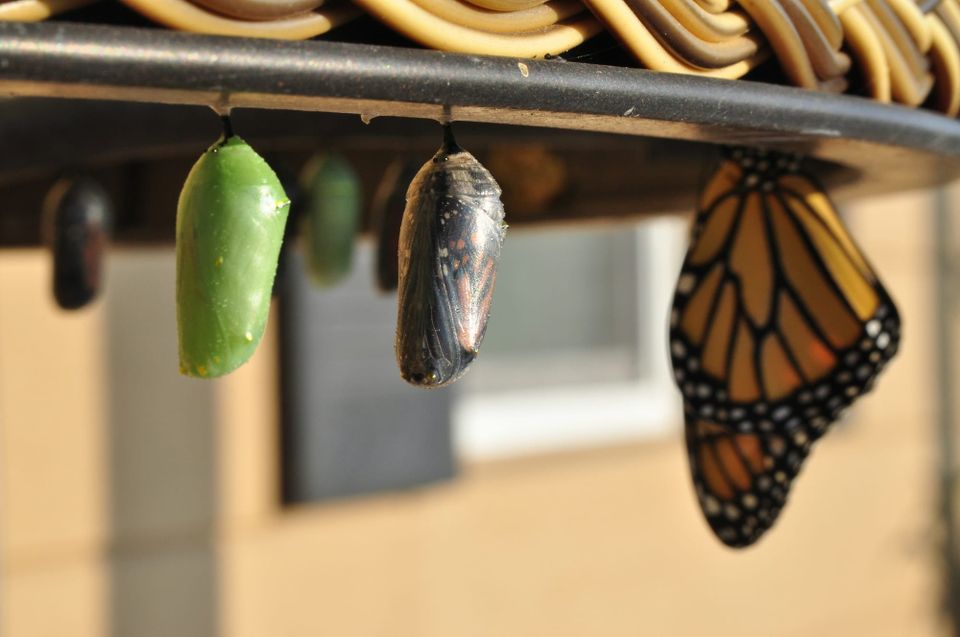
The event is a metamorphosis on par with adolescence and menopause, even though it requires an external trigger instead of being an internally timed process. To extend Jones' analogy of a caterpillar turning to mush in a chrysalis and then emerging as a butterfly, I very much recognize that there is a butterfly of sorts inside me, with my womb being the chrysalis, only there was no caterpillar inside of it at first. I am the caterpillar. But I am also the butterfly, transformed by something occurring with that internal chrysalis.
And here in my third trimester, more than at any other point in this pregnancy I wish that there were also a chrysalis around me. I have been social, but less than normal. I have not felt agoraphobic, but it bothers me less than usual to leave the house infrequently, and sometimes I prefer the idea of staying in. I especially do not want to travel or be away from home for longer than necessary. I don't wish to sleep away all the last weeks of gestation, but I wish that as this child gestates I could also gestate around them, our bodies nested together in some larger entity like Russian matryoshki. Where is my chrysalis? Where is the womb for myself, since my own womb is in use by another?
Thank you for reading.
I have not asked for financial support here in a little bit, so I should take this opportunity to ask anew. I have continued to break even on the cost of publishing Salt for the Eclipse, and I am privileged to have enough familial backing that my cost of living has been subsidized through my prolonged unemployment. However, given the givens, that cost of living is about to significantly increase. I do not think my family will be offsetting the difference; and this will not be helped by inflation, the fact that postpartum I will need to take at least a few months off from seeking much work, and some other issues. I still intend to continue my ongoing career realignment in a non-writing realm that should, if/when successful, make income concerns a more trivial matter; but until then, the more that I can somehow earn through writing, the better. If you have been reading for free, I would deeply appreciate any level of paid subscription.
Next week I have decided to take off for my birthday, but I will be back on the 14th with a paid-only post about the nuts and bolts of my personal journey toward satanic witchcraft.


Member discussion