Full Moon: What to guard & what to surrender
It's Saturday, and there are snippets of gold and red on the edges of the maple trees, and the nights are still muggy but growing ever cooler and longer, and the other night there was a near-total lunar eclispe. I couldn't bring myself to stay up and watch it, but I have had plenty of other rites and meditations requiring my attention. Hello.
This is a late post because of the usual reasons I keep needing to cite, and also because one of my current volunteering opportunities took place yesterday. However, it's also another post that felt right to squeeze in while I could, because I've meant to get to it for a really long time and the only thing that's delayed it is not length so much as an awareness of just how volatile everyone's emotions can become on this subject.
I consider it a responsibility of mine to address, though, as a ritualist whose practices partially incorporate certain elements of pre-Christian and reconstructed Germanic traditions that some people refer to as heathenry. More than any other geographically or culturally related ritual system, it is this one that has the most noticeable number of people looking over at it from other traditions and expressing sentiments like, "If I see someone wearing [symbol] or talking about their enthusiasm for [mythology], I just inherently mistrust their politics." And given certain events of the 20th century and those events' aftermath, I would say this mistrust is quite warranted. But what I want to say about it here is not strictly whether it should exist — although I will certainly start with that aspect — and more about a slightly higher level question.
Namely: if we on the left and/or in ritual subcultures recognize some merit in being cautious about the white man with the rune beads in his beard and the Mjölnir pendant at his throat, what are the symbols he could use that should be considered politically inexcusable, and what are the symbols he not only could use but perhaps ought to use and guard against fascist theft? And we must ask this question because despite how it might feel simplest and safest for the most mistrustful among us to just avoid all Heathen Bros, as it were, that strategy does not offer any guidance about symbol usage to antifascist ritualists who feel a longing to authentically adopt Germanic animist practices, whether as a matter of acknowledging specific ancestry or as a matter of cross-cultural resonance. The following thoughts are how I personally recommend approaching the matter.
To be clear: heathenry both isn't and is in a unique situation
To enter into this discussion in good faith, it's important to first acknowledge one problem with saying, "If I see someone wearing runes I inherently mistrust their politics." Despite the mistrust itself having a logical motive, heathenry is not the only ritual realm in which you will find white nationalist infiltration. Fascism and everyday racism are problems that all ritual traditions with any European ethnic origin have to guard against; some of the most severe issues I've heard about are, for example, found in Rodnovery (Slavic neopaganism). Furthermore, white ritualists following much more syncretic, culturally nonspecific traditions are in no way guaranteed to be leftists either, even if — perhaps especially if — their practices fetishize "exotic" "Eastern" knowledge systems. And in fact, ethnofascism is quite capable of emerging in cultures worldwide that the arbiters of whiteness would not call white; just look up Hindutva.
We need to bear these things in mind because otherwise, as I've occasionally written here before, simply equating pre-Christian Germanic (spi)ritual traditions with ignorant bigotry just leads to reinforcing two hugely damaging fallacies:
- That fascists have the most legitimate claim to those traditions, and
- That even though it may generally be bad for Christian colonization and white supremacist homogeneity to have affected any culture, for some reason when Germanic peoples were affected nothing of value was lost.
The first fallacy is jaw-droppingly preposterous, not only because fascism is much newer than something like seiðr but also because there is no reason to give fascists anything they have not already fully taken. The second fallacy is more complicated to unpack in the time I have today, but it still shouldn't take too much explanation for someone to develop a stance that either treating ancient animist knowledge systems as worthless barbarism is a bad thing to do, or it isn't.
I mostly wish to be clear about the above because among fellow white settlers with whom I ever discuss anything remotely ritual in nature, there is always a subset who are very quick to emphasize that they know just how sketchy Heathen Bros are, and they themselves are far too enlightened to incorporate anything as embarrassing as Nordic Stuff into their practices, and because they recognize such problems they are practicing Politically Safe Paganism that doesn't ever need to be interrogated for its own racism or colonialism. Maintaining such smug stances is not as clever as it looks. Not when it cedes unnecessary ground to the right wing, and not when lets the right wing even prey upon particular people by being some of the few to assure them that their ancestors' old ways had worth.
Nonetheless, I will now turn the conversation back around. For while we cannot conflate heathenry's image problem with some actual poison at the root of heathenry itself, we also cannot ignore that the image problem exists, nor can people who practice some kind of Germanic animism or casually use some symbol fall back on it being "just" an image problem and use this as an excuse to act however they like, associate with whomever they like, and so on. For building political coalitions in the ritual sphere it is actually rather crucial to not arbitrarily provoke or offend people you could be fostering alliances with.
I therefore have also been exposed one too many times to and have grown very tired of fellow white practitioners whose politics have developed far enough to recognize why we must not let fascist heathenry become any more of a thing than it already is, but whose politics also remain petulantly, "When I use iconography with questionable implications, nobody has the right to even ask why I've done this, and you are the real bigot for erroneously targeting heathenry versus alternatives."
To such peers I can only say that while it's decidedly unfair for any culturally specific symbols to have become associated in much of the popular imagination with a regime that systematically murdered millions of people and sustained itself partly through an inner circle of historically inaccurate occultists — we also do have to live amid the disgusting reality of what happened. We live in the aftermath. Accepting it means...
The obligation to vocally resist any further right-wing equivalence between specific heathen tokens & whiteness
This vocal resistance is a two way street. It means making sure that people on the left understand how, for instance, a particular rune does not inherently have the meaning that fascist heathens have assigned it; but it also means spending equal energy on openly opposing those fascists' activities, whether that involves directly disagreeing with them when they speak, publicly refusing to take part in events where their presence will be tolerated, or what have you. If somebody can complain about heathenry's image problem but can't take meaningful action to present a counter-image, they are not going to do their argument any favors.
Of course, I do not wish to imply that the only precise, correct way to conduct vocal resistance in this matter is to spend all one's free time going from heathen space to heathen space in hope of finding neo-Nazis to toss out, or assembling street actions, or getting into online arguments with fascist heathens who have no genuine interest in having their minds changed. Vocal resistance can — and should — also look like speaking up when infiltration is attempted in the space you already belong to, or like building inclusive ritual community that has nothing to do with the internet. But even just to accomplish these subtler, more localized activities, this requires a strong focus on integrity, which itself involves acknowledging that the company you keep, the media you endorse, and the ways you adorn yourself all affect your reputation whether you like it or not.
As a result, if I want to build solidarity with certain people who may be inclined to scrutinize the aspects of my ritual life that are underwritten by Germanic animism[1], I should be willing to jettison certain symbols when there is really no chance of rehabilitating them; even as a largely solitary practitioner, if a symbol has little community significance beyond something divisive, corrupted, or cursed, it's almost impossible not to carry that sickness into what I do on my own. And likewise I make a point of using certain symbols freely but explaining them without resentment when interrogated; if the explanation does happen resentfully, then the listener is likely to just absorb the negative emotion.
A review of symbols
With all of this prologue in mind, this list is not supposed to be a definitive reference for whether if you see someone using a particular symbol this automatically means that the person is "safe" or "unsafe." I cannot exhaustively include every pertinent symbol that practicing heathens use, or that's confused for being heathen even though it's not. I am also not the kind of person who knows every hate group imaginable or the real underlying personalities of famous individuals with questionable tattoos. And finally, context always matters. There are some symbols I'm listing here that I would expect only a ludicrously ignorant person to utilize without being an earnest ideological fascist, but some ludicrously ignorant people do exist[2]; there are also symbols that I still consider utterly benign but that thus say a lot less about the user's politics compared to whatever the user explicitly voices and what their actions show.
So instead, this list is here for the sake of illustrating a) how certain long-established heathen symbols do not have to carry any far right meaning that we are not ourselves willing to let the far right establish, b) which symbols I do advise regarding as already permanently corrupted, c) which symbols are completely modern fascist inventions that we don't need to mourn, and d) how useless it is to reduce all heathen symbols to "universally safe" or "universally dodgy" if there is any goal of guiding white heathens toward actual ancestral recovery (and reparations owed to other groups) and away from whiteness itself. I would also welcome others' interpretations of these symbols if you're approaching the issue from my same mindset but you're substantially more immersed in heathen practices and currents than what you'll find in my more piecemeal approach.
One last note: for symbols I consider permanently corrupted or that were invented by fascists in the first place, I am not going to directly show them in the body of this post, because even if you somehow don't already know what they look like, I do not want their energy besmirching a space I maintain. Look them up in your own time if you really require a visual reference.
Swastika - Both the "right-turning" (used specifically by the Nazis) and "left-turning" forms have a history in ritual art, textile motifs, etc. across many parts of the globe, and this does include pre-Christian Germanic cultures. I of course have no business saying what people from most swastika-using cultures should do with the symbol for their own purposes. However, while it would be very, very, very wonderful if people with my demographic privileges could still meaningfully access the swastika as the magnificently complex indicator of the Sun and wheeling seasons as it once probably used to be for some of our ancestors, the necessary work for repairing what the Nazis did has been left so utterly undone that among white heathens the swastika has no appropriate place — especially not the right-turning form, but the left-turning form would be a fairly bad faith substitute. This is one area where I genuinely refuse to hear counterarguments and am shocked whenever I do. Maybe in hundreds or even thousands more years it will be possible for white heathens to have some kind of productive relationship with the swastika, but the necessary process to rehabilitate it could also take forever. It could never happen. Even if it did happen, we cannot rush it and in the interim we cannot even get wrapped up performatively mourning the symbol's loss. To let it go for the time being, we must actively work with other symbols rather than focus on what we cannot work with. Not even ironic usage for provocation is worth it.
⊕ (Sun cross) - This is a symbol that some hate groups have chosen to adopt, and I would consider it worth contextual scrutiny. However, it's a symbol that goes back to at least the Bronze Age and has yet to be adopted by any organization with the same scale and impact as the Nazi Party. In my opinion there is just enough completely neutral usage still in play — along with usage that's not culturally/ethnically specific — that it is worth not yet ceding to fascists, especially when another solar/seasonal symbol has already been lost. I would ideally like to see heathens prioritize the Sun cross as a counter-symbol to the swastika, especially if they/we can use it alongside openly antifascist symbols.
Wolfsangel - Although a medieval German symbol that originally related more to folk magic, peasant revolts, and a variety of different political movements, outside of Germany it has never really been used in a neutral way. Given where I live, I do not use it and I inherently look askance at anyone who does.
Valknut - Linking to Wikipedia so that you can see images, since there is no Unicode version. This is a very old Germanic symbol that may originate prior to Christian conversion, and there's a lovely amount of scholarship out there exploring what it could signify. Over in Scandinavia these days, it is certainly not treated as an intrinsically fascist symbol, and in general like the Sun cross it has not seen the same degree of 1:1 fascist equivalency that's taken place with the swastika or the Wolfsangel. However, similar to the Sun cross again, just enough fascist groups like to use the Valknut that protecting the symbol from them is a very active battle. When I encounter the symbol at random, context is everything.
Mjölnir - Similarly linking for an image. With this symbol, in my experience so many leftist, centrist, or "apolitical" heathens make use of it that although it's still important to guard and watch the conext, I do not think someone is really well-informed if they see an inherent problem with wearing a Mjölnir pendant. I am definitely not enough of a self-identified heathen to wear one anyway, and even if I were I still wouldn't because Thor is just not a god I particularly work with. But political optics play very little role for me here.
Black Sun - Although this has roots in designs that are much older than the Nazi Party, the design as it's currently recognized was 100% commissioned by Heinrich Himmler. If any modern heathens have ever misguidedly adopted it without knowing its background in the first place, they can and should abandon it without a second thought.[3]
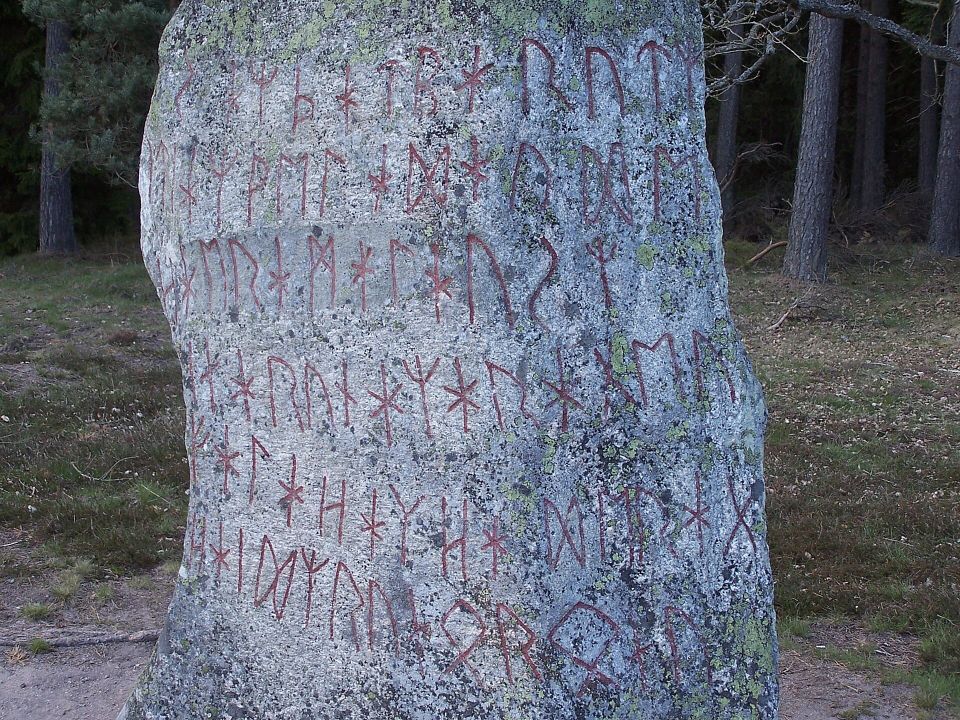
Futhark runes (ᚠᚢᚦᚨᚱᚲᚷᚹᚺᚾᛁᛃᛇᛈᛉᛋᛏᛒᛖᛗᛚᛝᛞᛟ and certain variants) - These are all historically neutral enough to the point that I strongly advise regarding them as benign unless a) they appear alongside much more questionable indicators, b) certain runes are presented in very specific ways (like putting two ᛋ runes next to each other as the SS did, or depicting ᛟ with little "tails" at the bottom), or c) certain runes are identified by their users/wearers according to novel meanings that the Nazis assigned, such as ᛋ symbolizing "victory" rather than the Sun, or ᛉ symbolizing "life" rather than protection.
Armanen runes - These are modern anachronistic letters created by the racist scholar Guido von List. Some of them match runes in the Futhark, but many do not, and the phonetic values for "matched" ones do not always correspond the way they ought to. These letters and the novel meanings assigned to them are often what the Nazi Party actually used. Therefore, we can handily toss out the whole system.
On that note, I now finally have other things to address for the rest of the weekend, but I hope I have laid out all my thoughts about this as clearly as I have needed to.
[1] I do not personally call myself a heathen even though it feels like the appropriate shorthand to use throughout this post; that is, heathen would not be a totally inaccurate descriptor for me, but since I neither practice with a larger heathen organization nor center heathen traditions compared to some other parts of my practice, I tend to think of my witchcraft as just pulling from some of the same historical substrate as formal heathenry.
[2] Trust me. I encounter them all too routinely.
[3] This should not be confused with the alchemical concept of the Black Sun, which has completely different origins and history but therefore also no bearing on this post.
Thank you for reading. I'm glad to have this one out here at last. Next week assuming no biological surprises I'll have a post for Occult subscribers only, and the following week I'll have a cannabis-related post for all paid subscribers.



Member discussion