Full Moon: A theory of divination (Part I)
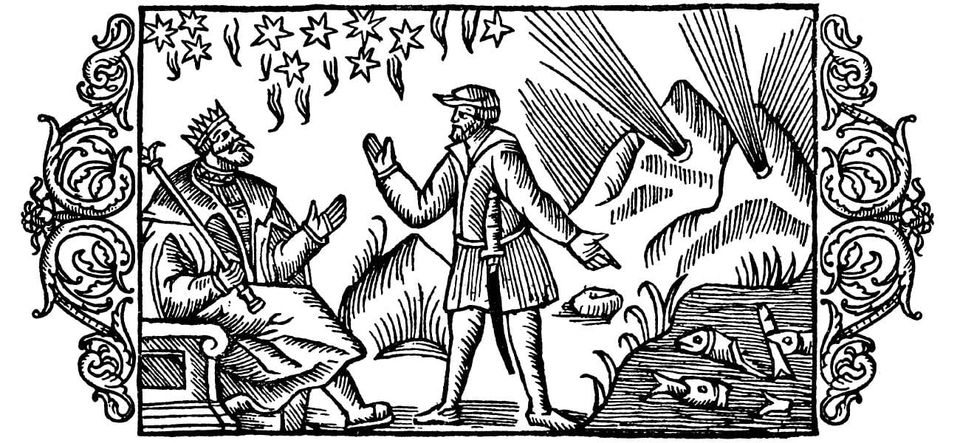
It's Friday, and the poppies here have bloomed, and so have the roses. Dragonflies have begun to stalk the bees and wasps. The air is yellow with pollen, and every night is brief. A few nights ago, the Full Moon was a "blue" Moon, and my tarot reading — though always very intense lately — offered me a very special reminder. Hello.
Since beginning Salt for the Eclipse, I've written quite a few posts on various forms of divination, including the methods I practice and those I'm still only curious about. In my first such writing, focused on tarot itself, I did provide some explanation of why I find divination valuable even though I have very little trust in modern divination frameworks that describe such practices as literally predicting the future or uncovering otherwise impossible information; I've since revisited my rationale here and there. However, at some point I realized I've never discussed my theory of divination in a way that metaphysically and psychologically encompasses everything I believe is "really" going on. I've referred to divination as a pragmatic tool, an animist communication technique — but I haven't yet dedicated any post to a taxonomy of those techniques, nor to an deep ontology of the act of divining, nor to some overall considerations of when it's appropriate to practice divination and when it isn't.
Again, I've brushed up beside these matters before; I just haven't put them squarely in my focus for others to read. I did this with the topic of spellcraft because of how I was only then bringing myself around to the prospect of integrating more spells into my rites, after years of essentially positing, "I'm a witch — but not in that way, mind you." With divination, though, I felt as if I didn't need to convince myself of anything, and I knew my readership well enough to guess they wouldn't need much convincing, either.
I think that maybe it's time to pivot back to some overlooked first principles. I want there to be less ambiguity about how and why I divine, and perhaps this will provide some inspiration to any of you who have liked the idea of divination but have found yourselves at the same distance I used to (and sometimes still do) have regarding spellcraft. And if nothing else, while you can read all my older posts about divination if you wish, I suspect that when I started this newsletter I was more of a skeptic about some things than I am now.
This is going to be the first part of a two-part essay, because I've wound up writing on low reserves and I don't want to rush the end as I sometimes do. In this part, I will therefore focus on the most metaphysical issues, and in the next part I'll move on to practical implications.
Problems of time & space
These days, if someone reads cards, celestial events, runes, palms, tea leaves, dreams, fires, or anything else you can think of, they often tell themselves — or tell the people they're reading "for" — that the tools in front of them will grant insight into something that will happen that day, that year, within some lifetime, or at least eventually. The predicted event may be the resolution to a situation that someone is wondering about, or it may be the start of a brand new situation. Now of course, people do not only divine in order to predict the future, which I'll come back to in a few moments; but it should be safe to say that some kind of forecasting is one of divination's most common use cases.
If it is possible to see the future at all, this could be implied by three possibilities I can fathom:
- Time moves in a linear fashion, and all events on that timeline are inescapable effects of their respective causes, so divination allows someone to understand those effects, no matter how far ahead they may arise.
- The "forward" movement of time is an illusion, and it is simply our perception that bears witness to events in a linear narrative, so divination allows someone to force their gaze ahead and see something that's already happened, before the rest of us would see it.
- Time is cyclical, and all events repeat in various ways such that based on how something has happened before, divination allows someone to predict what the next repetition will be like.
As an animist, I have to reject the first scenario because of the entropic logic; and even fully empirical astrophysicists these days might be coming around to the chance that the universe is not simply evolving on an arc of permanently increasing entropy. That topic could form the substance of an entirely separate post, so I will not dwell on it here. But the two other scenarios I've listed still do not concretely tell me how someone could shift their perception, or how someone could most effectively prophesy based on the past; they only suggest things that would functionally have to occur.
Let's now complicate this further. Consider that divination along some spectrum of time does not have to involve looking at the future; it's not limited to "fortune telling," so to speak. People also attempt divination to find out previously hidden information about things that already happened; this could take the form of spirit mediumship to ask a ghost how they died or what happened in the house, or it could take the form of extrapolating traces of the past from objects that have been left behind. This may also be regarded as clairvoyance[1] but on a material level it can involve the same deductive reasoning skills used by geologists, paleontologists, archaeologists, historians, wildlife trackers, forensic investigators, etc. — just applied to a far more esoteric set of clues. If we think in this way, then when it comes to the actual fortune-telling we could also align it with materially grounded prediction sciences like meteorology or economics[2].
One of my favorite takeaways from Tyson Yunkaporta's Sand Talk is how he weds a relatively empirical mindset with an animist one, and the book effectively dispels the Euro-colonial pop culture view of indigenous knowledge as being something intrinsically "just" spiritual, clarifying that all dualistic distinctions between the material and the spiritual are nonsense; the real indigenous knowledge concerns both simultaneously. Thus Yunkaporta observes how a wise elder in a particular community can predict rain with an accuracy that would seem like improbable magic to a so-called Westerner, when it is really nothing more complicated than the elder knowing exactly how to read the land and sky for signs that rain is coming. If you learn material patterns of things, this is learning the cycles of things that can inform your understanding of what's yet to come. The most knowledgeable pattern-learners may be the real prophets.
But we do need to draw a line with some of this. It could feel sensible to predict that the river will flood, or to extrapolate that once upon a time there was a great flood. It instinctively seems like much more of a stretch — at least to me — to predict that a person will absolutely win the lottery, or that the recipient of a person's affection will unconditionally reciprocate. Lottery odds are awful. And maybe I can guess that two friends of mine will get together, but how can I predict the romantic inclinations of someone I'm only hearing about secondhand? For several years now I have struggled with problems of this nature. Perhaps divination works after a fashion, but do we essentially have to draw the line between soothsayers who play it safe with the right topics and soothsayers who get overly ambitious, or high on their own proverbial supply?
Suppose we draw that line somewhere. Then what is the actual point of performing divination as magic, given it can't tell you anything about the future or past that you couldn't also learn through a non-magical discipline?
Time is not even the only obstacle here. There's also space. Consider dowsing, remote viewing, and anything else where you find out something from one place while you remain in another place. Materially this does not seem possible and I have never attempted it. But if somebody did succeed at it, would it be again because of making educated guesses, or would they have some trick for disrupting the laws of physics so that they can place their senses in two places at once, or use their senses across an otherwise impossible distance?
Toward this question, too, I have previously adopted the stance that there are material limits on what can be divined, and thus the practice should be used for psychological purposes. But I worry that when I say this it could be mistaken for saying we must strip away divination's magical quality. The psychological is the psychic, and what is psychic is magic. And like I said above, the divide between the material and the psychological is not really there. The material is just what most of us can agree on perceiving most of the time. It would take an exceptionally powerful person to fully reshape the perception of most people around them, but ask anyone who's fallen victim to a charismatic cult and you will understand just how plausible this is.
Despite these caveats, though, there is also not much point in trying to divine the future, past, or distant present if you are dead set on receiving information that feels 100% certain and can be confirmed 100% by other means. This asks reality to be more constant and reliable than it is. The longer that I've been practicing any sort of witchcraft, the more it seems like such divination objectives are built on modern, rationalizing terms for something that cannot properly be understood by the modern, rationalizing mind. I think we need to avoid the tendency to think of divination as a quest to find a particular "if/then" proposition in the fabric of the cosmos, just as I've previously suggested we not think of spellcraft as forging our own "if/then" conditions.
Instead...
Divination as unveiling
As a word, divination comes from the Latin verb divinō, which is generally used for the sense of fortune telling and prophecy, and ancient Rome had more than its fair share of people who provided these services. But divinō shares the same root that gives us divine, and I find this interesting as a hint that originally "to divine" would therefore mean to connect with the divine and come away with knowledge.
Other translations of divination that do not necessarily revolve around fortune telling include:
- Finnish selvännäkeminen - "clear-seeing," aligning literally with clairvoyance[3], both words implying perception without obstruction
- German Wahrsagen - "true-telling"
- Ancient Greek μᾰντείᾱ (manteia), from μάντις (mantis), itself from μαίνομαι, (mainomai) - "to go raving mad"
Naturally, many languages' terms for divination do have straightforward etymologies about prediction, fortune, etc.; I suspect there is a childlike vision of divination that has existed throughout human history, wanting things to be so easy even before modernity. But to me it also seems like the people who perform this kind of work are not so much predicting anything as they are perceiving a truth that other people normally do not perceive. The above words imply that at least some cultures have recognized this in the past, too.
To perceive the truth that is not normally perceived, this requires either looking slantways at ordinary things or stepping slantways into an extraordinary space. Whatever the unperceived truth is, it is beyond the veil, so the veil must be drawn back or we must go past it. One way or another — perhaps through training with a specific tool, perhaps through training with a specific "data set" of celestial or terrestrial occurrences, perhaps through chemically altered states of consciousness, or perhaps through other altered states — we must induce a pattern recognition mechanism that to the outsider will seem like both poetry and madness. Indeed, ideally it is madness, maintained in right relation and in short doses.
By this means we discover just how much we do not know, but we also swim in fiction, imagination, and free association until we return to the mundane — and we bring with us a better instinct for things like how to handle a situation for the best future outcome, even if that outcome is too fluid to be certain since our own actions might change it. We likewise bring with us a better instinct for how to make sense of mysteries in the past or present, even if we still can't guarantee certain facts beyond the complexity of what our own minds can absorb.
With enough practice, I think that even though the discipline of divination leaves us far from omniscient, it makes adaptable to what cannot be predicted. This makes the unpredictability less frightening. And is that not just as good as knowing the future, if not superior?
I will continue from these thoughts in a few months.
[1] What is the difference between clairvoyance and divination? I'd crudely say that a clairvoyant is someone who does not need external tools in order to obtain the information a diviner would find; they simply receive visions, perhaps not even by intent, whereas divination itself presumes "reading" from specific signs. But for purposes of this post, I am lumping everything together because whether or not a genuine clairvoyant has ever existed, their ability would presumably be nothing other than a more efficient means of tapping into the knowledge pool that divination is meant to facilitate.
[2] Most economics is frankly just the most legitimized form of divination in modern society, but that's another separate conversation.
[3] See [1].
Thank you for reading. Again, I used up a great deal of my mental capacity today on this piece and on handling some unrelated things, but hopefully it's at least coherent. Next week, I'll have a post on the concept of an afterlife, and the week afterward I'll have a Litha holiday post exploring the mystery of ecological complexity through midsummer abundance.



Member discussion