Full Moon + Solar Summer: To gather a bundle of May
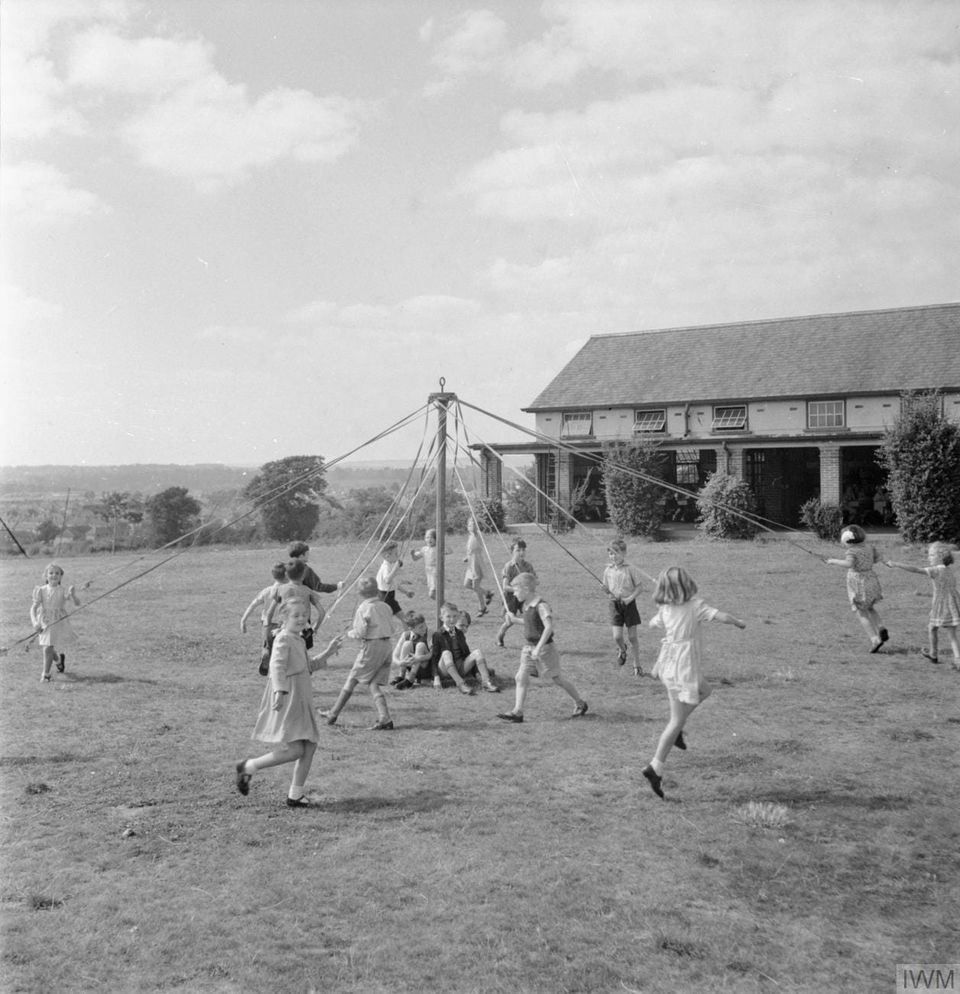
It's Friday, and by wonderful chance this year the Full Moon has aligned with today's holiday of Calan Mai (Beltane or May Day to many of you). Hello.
Although the Friday timing does mean I have had to scramble a little to fit this missive in among personal observances, this particular lunisolar timekeeping overlap has still given me an ideal opportunity to address a topic I had avoided until conditions precisely of this nature. That is to say, after a few years of writing Salt for the Eclipse — O lord, how strange! — it finally feels right to examine the abundance of traditional May 1st practices that have endured for at least some centuries, and to ask whether their clearly pre-modern nature shows one of the few ways that pre-Christian rituals and beliefs have incontrovertibly endured despite the loss of most coherent European animist cosmologies in the places where the holiday has been prominently celebrated.
It will do no harm to warn in advance that my answer is a pedantic "no and also yes," because this post is going to be more about the journey than the destination. I do need to apologize, however, for the fact that I'm not equipped to comprehensively review all surviving traditional May 1st rituals; by and large, I'm going to examine practices of Great Britain, where rites of either Celtic and Germanic origin (or both) have mingled together in a very specific way that I've been personally familiar with for decades. Where possible, I may cross-reference Celtic practices beyond Britain, e.g. in Ireland, but for a more dedicated look at the overall "ancient Celtic calendar" I suggest reading this older post of mine. Also, there may be practices I discuss that have parallels in other Germanic cultures, but besides knowing that some hallmarks of a British May Day like a maypole tend to be transferred over to Midsommar in the likes of Sweden, I am simply not that well versed so I welcome points of comparison from other people — likewise comparisons with cultural animisms I know even less about.
I also need to apologize for the fact that even within the narrow scope of May Day on Britain, I cannot cover every possible ritual token that might enter my or your mind, not in one post. But a tidy little framework I can use for today is a set of tropes that are semi-reverently represented in the 1973 folk horror classic The Wicker Man, set on and around May 1st in a remote neopagan community. I have brought that movie up before here, but now I'm referencing it from a slightly different angle.
If you don't want to be "spoiled" on the actual plotline of the film, then I recommend avoiding the summary I'm about to provide next; the ritual elements I want to highlight are covered in a plot-free way afterward. But either way, enjoy this gathered bundle of May.[1]
May Day as The Wicker Man sees it
I am needless to say a great admirer of The Wicker Man. Its politics are not perfect — the male gaze emerges in particular ways that feel unsurprising for how 1970s occult or neopagan images were often conveyed — and from top to bottom it's engaged more with a meta-myth of British pagan history that belongs to Frazier's The Golden Bough and similar works, rather than working off of an academically rigorous understanding of the Celtic and Germanic animisms that swirled together to produce various folk traditions that are replicated across Britain every May 1st. Despite these fundamental critiques, it's a brilliant piece of filmmaking from a formalist standpoint, and it tells an excellent story that conveys what I would still consider a British[2] animist spirit, a vibrant "fuck off" to modern Christian hegemony as well as police states.
The story is told almost wholly through the perspective of police sergeant Howie, an uptight and utterly devout Anglican who has been dispatched to a remote Scottish isle in order to investigate the reported disappearance of a girl named Rowan. As soon as Howie arrives, he finds his investigation sorely hampered in strange ways; the first islanders he encounters fail to recognize the girl's photo, and the more people he speaks to, the clearer it becomes that they're revealing only tiny scraps of information about Rowan at a time. It's as if everyone has something to hide, and by the time it's suggested that Rowan may indeed have met with grave harm, Howie is by turns afraid that she's already dead and afraid that she's been hidden away prior to her sacrifice in what he imagines as a violent, barbaric ritual. For even as he finds the islanders reluctant to discuss Rowan, he also finds them a wellspring of information about their religious practices, which appear to be a pagan revival movement spurred by the ancestor of their leader Lord Summerisle. Alarmed by and scornful of willing pagans remaining in Britain, as well as driven mad with guilty thirst for the innkeeper's joyously promiscuous daughter, the police officer grows distracted from his own mission even as he gets closer and closer to finishing it.
In the end, the islanders have given Howie all the clues he should need to solve the mystery of Rowan, but in his chauvinism he has failed to consider that while the pagan practices around him are quite sincere, the islanders are not ignorant, lascivious bumpkins falling all over themselves to hide a very obvious murder under his nose. No, the islanders are quite calculating, and Rowan is not their intended sacrifice at all; come May Day, Howie tries to disguise himself in their parade and thus save the girl, only to be led into a trap where he finally discovers he will be sacrificed, burned alive inside a giant wicker effigy. He was right that the islanders have intended to make a ritual offering to their gods in order to make up for a devastating crop failure that happened in the previous year. But he didn't realize that as a representative of the royal government, he is a stand-in for a king, and a king is the only fitting sacrifice for these circumstances.
Howie's death at the end of the film is certainly horrific, and because the audience is generally tethered to his own perspective it may be tempting to imagine from the above synopsis that the pagan islanders come across as monstrous, evil people. But The Wicker Man threads this needle perfectly: Howie makes a crude, patriarchal embarrassment of himself time and again, and while the islanders' final celebration of human sacrifice palpably occurs in a realm of morality that goes against what most people in my own society would condone[2], there is a strong mythic undercurrent throughout the story that suggests Howie may in fact deserve to die for the crime of hubris against the true gods of the land. Even if you don't buy that last claim, I would still argue that the islanders' beliefs and practices are written with such earnest care for the subject matter — it's quite apparent that these people are intended to at least seem much more sympathetic than how the police officer regards them.
Year by year, The Wicker Man seems to be embraced more and more by viewers who resonate with the paired themes of recovering a pre-Christian, pre-modern lifestyle and of destroying any ruling authority that sees itself as above the true law of the land. It's a story that magnificently encapsulates May 1st as a simultaneous pagan-animist and leftist-revolutionary holiday.[4] But without going much into the politics this week, and focusing more on the film's depiction of what's essentially some British pagan reconstructionism, I imagine newcomers to the subject matter might well ask, "How accurately does this film represent pre-Christian animist beliefs or practices around May Day, all things considered?"
As for the beliefs, no one can really say, and this is not just because Britain's ancestral animisms mostly relied on an oral tradition that has since been annihilated or at least heavily disrupted; remember also that there is no such thing as a singular animist ideology, even within a given cultural context, because animism is a way of relating rather than a religious doctrine. It is therefore rather telling on The Wicker Man's creators that they present the islanders as even following "a religion," although it makes some diegetic sense insofar as they do practice a modern construct rather than a direct recovery of anything older.
But as for the practices, most of these are certainly quiet authentic — at least if you accept that actual modern May Day rituals in Britain, as sometimes copied across the anglophone world and mirrored in other European cultures, are themselves derived from pre-Christian traditions. Of course, those actual modern rituals do not include throwing a human being inside of a wooden effigy and setting everything ablaze, so that's one key exception. But let us take a walk through some other rites that either feature in The Wicker Man or are strongly hinted at. And in fact, I would like to start from the premise that while the "wicker man" is superficially just a piece of Roman imperial libel against the ancient Britons, one modern token of May Day does rely very much on a liminal entity between man and tree.
Green Man & May Queen
A staple of many English May Day parades is a figure known as Jack o' the Green; this is a man wearing a wicker frame covered by green foliage, ideally fresh but of course these days artificial — in some cases. The practice is attested no earlier than the 17th century, but there's no clear evidence as to whether this means it was invented at that time versus somebody finally mentioned it in a document that survived for modern folklorists to study. Many of those same folklorists have compared Jack o' the Green to the Green Man motif in related traditions that include the decorative stonework in many old churches, and some scholars take the position that this indicates past worship of some forest god in the "wild man" vein, such as Dionysos or Pan.
And although the overall academic consensus now appears to be that we should draw no such conclusions, this idea has certainly spread into the popular imagination. Nowadays, Jack o' the Green can appear — as I have personally seen — synonymously with more anthropomorphic Green Men, i.e. men in green leaf "suits" that give them freedom of movement to truly cavort in parades and festivities. Alternately, men might wear even more tree-like costumes with faces carved in them that call to mind Tolkien's ents.
It's not a man who is killed in a wicker cage, but it is a tree-man of some kind. What is the ancient significance of this? I don't know, but I think there is something. It does not have to be a specific god, although I understand why modern embrace of Cernunnos (including my own) can incorporate such imagery. Rather, it matters to blur the boundary between human life and plant life. Perhaps this festival figure was invented as a subconscious recognition of our relationship to plants, especially worth recognizing in the season when leaves erupt from their buds and crop seedlings hopefully start to flourish. And for this purpose, does it matter whether pagan Britons invented it, or pagan English settlers brought it with them, or Christianized but still land-connected British villagers followed a lingering animist instinct? If nothing else, it's crucially a pre-industrial practice.
A figure who is not necessarily directly paired with (Jack o') the Green Man but who feels quite akin to him and usually strikes me as his feminine counterpart is the May Queen. The tradition of the May Queen definitely appears in The Wicker Man, and I think it may be somewhat well-known beyond those of us who grew up learning anything about May Day rites. This is an elected role held by a young woman (sometimes just a girl), wherein she is dressed in white, crowned with fresh flowers, and leads the holiday parade. I'm fairly convinced that this has carried over into prom queen traditions in the United States, and the homecoming queen by extension.
There are various other duties that a May Queen might carry out depending on the community, and there is in turn abundant folkloric speculation as to more apocryphal functions that link with speculation about why May Queens started to be chosen. They have been chosen since at least the Middle Ages. I don't think anyone has found any definitive explanations, and especially not any proof for some of the wilder hypotheses that float around. Personally I would love to know more about the relationship between the Green Man, the May Queen, and the medieval to post-medieval pantomiming of folk heroes like Robin Hood and Maid Marian, who may show up in May Day parades or other events around that time. And what of the crossdressing "man-woman" highlighted in The Wicker Man? This is straight out of British pantomime as well, especially since Maid Marian herself has often been a crossdressing role, but as a gender-complicated witch I'm drawn like a moth to the flame whenever ritual gender transgression takes place, since so many people like me worldwide tend to become boundary-crossers in a magical sense.
What's going on here? To ask is maybe a fool's errand. It might be enough to recognize that ancient motifs repeat themselves again and again, no matter whether anyone is consciously preserving them. But speaking of fools...
The Fool & the 'Oss
At one point in The Wicker Man, the relatively antagonistic hero dresses in a costume identified only as "the Fool," aiming to hide himself in the May Day parade. I am not so personally familiar with Fools appearing around May Day, but whether for this holiday or for general folk festivities I understand the Fool's inclusion as an archetype.
This is a carnival, trickster figure. He resembles the court jesters who could get away with making sharp social commentary under the performance of being a psychological Other[5]; he also resembles the centuries-old puppet show character Punch, who in turn is based on the stock character from commedia dell'arte known as Pulcinella. Pulcinella is a nearly Shakespearean fool: perhaps very intelligent but hiding it under a mask of buffoonery, or perhaps quite ignorant but thus enjoying true wisdom. The same such Fool appears as card 0 of the tarot.
In the cosmology that I follow, the Fool is not a predominant archetype of Calan Mai, belonging instead to Ostara; all the same, tricksters merit a place in any holiday rogues' gallery given their violently regenerative potential. What exacly is the Fool doing here? It likely matters less than the fact that we see him at all.
The figure in The Wicker Man who rounds out a triad with the Fool and the aforementioned man-woman is a Hobby Horse, which reflects another frequent May Day parade figure in reality. These Hobby Horses are not to be confused with the imitative horse heads on poles that children pretend to ride around, although the designs may have a common origin.[6] The "adult" version, as it were, is more like the novelty costumes you find where two people together share a fabric draping and headpiece that makes them look like a horse, except in this case the costume is generally for one person and so their legs are hidden behind a draped cloth (similar to a jousting horse's caparison). Also, for some communities that feature Hobby Horses — or 'Obby 'Osses as they're called in regions like Cornwall — the truly horse-like qualities have become highly stylized to the point where they sometimes don't even resemble horses anymore.
Nevertheless, a common practice with the 'Obby 'Oss is to have the bizarre creature chase young women around, who goad it with various implements, and if the creature catches those women underneath its large skirt, it releases them immeidately but the incident is seen as a kind of good luck or fertility blessing. I will leave it to your imagination as to how that has anything to do with getting caught under a horse; but of course the persistence of this practice and some raunchy jokes that often go alongside it can invite a very tempting assumption that the rite of the 'Oss is the clearest evidence that most May 1st rituals date back before Christianization, because surely such a chaste religion would not induce such activities to emerge in its midst. The 'Oss and its ilk must have stubbornly survived from an earlier time.
So we might suppose. But as I have hopefully driven home through many other writings here, and as you'll also find from people I periodically reference like Ronald Hutton or Rune Hjarnø Rasmussen, an animist practice within a traditional European knowledge system does not have to have arisen before Christianity, whether or not the practitioners self-define as "pagan." Syncretic folk-Christian animism is a real and pervasive phenomenon, especially in pre-industrial populations; likewise, when someone claims that there is a fully unbroken chain of pre-Christian European myth and ritual that has endured for centuries despite Christian repression, we can believe that or not but if it is true then it would simply not make sense to presume the unbroken chain has also never evolved. What we can access now is not what we could access before the first missionaries spread, and this fact would remain even if those missionaries never spread, because no traditional knowledge system remains utterly static through time.
We do not and cannot know if the 'Obby 'Oss itself has survived for thousands of years. But would it be fair to guess that it may be a recent evolution of some older practice, even if we don't know what that older practice was? Well, perhaps.
Maypoles
This is now the right point to briefly turn our attention to maypoles. One of these appears in The Wicker Man, and they're another key element of most British towns' May Day gathering, especially in England. Indeed, the maypole is most likely of Germanic origin rather than Celtic; even though it's been taken up in the Celtic nations, there the trend for Calan Mai, Beltane, etc. has more been for great bonfires, mirroring those at Calan Gaeaf (Samhain). While it's not impossible that southeastern Celtic Britons already had developed maypole rituals before English invasion, most other parts of Europe that use maypoles are either culturally Germanic or have had close historical contact with those groups.[8]
But most of the time, these details of maypole scholarship are not what interest people. My thanks to Prof. Hutton nonetheless, but I know the factoid on everyone's minds is usually, "Did you know that maypoles are phallic symbols?" and of course The Wicker Man plays right into this by having some schoolchildren repeat for their teacher that the maypole right outside represents a penis. So... does it?
Once again, we do not really know. On the one hand, the typical topper for a maypole is a garland of flowers, and maybe the maypole is just meant to serve as a way of holding some flowers high up. On the other hand, flowers are nothing if not potent fertility symbols of their own, and not even symbols, being very literal plant genitalia. On the other other hand, we cannot dig up the first person to erect a maypole and ask them what they were thinking about. On the other other other hand, trying to identify original intent is always futile because symbols' meanings are fluid. Somewhere down the line, the collective imagination decided that a maypole is phallic, so that's what it is now. The traditionally gender-dichotomous dance to do around the maypole is now a ritual courtship dance, no matter what it used to be.
To be continued...
I've spent a decent bit of space on the above tokens of May Day in Britain, whereas some things I've skipped over completely include ritual bonfires (a particular hallmark of Calan Mai/Beltane in Celtic communities, and featured only in parallel by The Wicker Man) or morris dancers (not really appearing in The Wicker Man at all, although there may be a tribute of sorts). There are a host of traditional May tunes with cryptic meanings, some featured in that film and some not, that I've likewise missed. I would like to come back to all of these at some point.
But because there is not infinite time, for now I simply wish to end on the concept I have floated repeatedly throughout what I did cover: that whether the traditions described have been around in a well-preserved form for millennia, have evolved over those millennia into a different but related form, arose post-Christianity out of a forgotten pagan substrate, or arose post-Christianity from a surviving impulse that says nothing of the substrate, the exact truth does not matter. What matters is that the practice endures now, is decidedly not Christian even if it may allow for pluralistic adoption, and is interlaced with a rich web of animist lifeways to preserve seasonal land relation despite living in a system that has long been bent on destroying such things.
Gather whatever bundle you can make of whatever May we have. Carry it forward. And burn the false kings behind us.
[1] Which can refer to gathered flowers in general, or can also refer to the traditional May-flower: hawthorn, whose white blossoms create a striking sight around this date in its typical ecosystems. However, hawthorn flowers are not really supposed to be brought indoors while fresh; they are Otherworldly, smelling like death due to releasing trimethylamine, and so anyone in their right mind would use them to ward fairy mischief outdoors but not bring that energy into the home.
[2] Normally I don't refer to "British animism" because a) I would rather not create confusion about whether by British I mean "of the island of Britain" or I instead mean a national identity, and b) I typically explore components of British animism through discrete Celtic or Germanic lenses based on whether I'm interfacing with what my Brythonic Celtic ancestors (may have) practiced versus interfacing with pre-Christian English settlers' (and Viking raiders') rites and cosmologies. Despite my typical choice, though, in today's post I find it worth dropping this footnote to observe how although the nation-state of "Britain" i.e. the United Kingdom ought to dissolve on various grounds, the land-that-is-Britain has forged animist relations with more than one people, and this is reflected in the folk magic and holiday traditions of Britain often reflecting certain ethnolinguistic qualities but rarely belonging to just one subpopulation.
[3] And just to be very clear, I myself do not support "bringing back" real human sacrifice, for a number of reasons which are more complicated than just right versus wrong — but are still rather ironclad. Symbolic human sacrifice is another matter, though, and I also choose not to judge cultures past or present for engaging in human sacrifice as if this practice has made them uniquely terrible compared to, say, cultures that feed thousands of young men (and sometimes women) into a military meat grinder that then murders tens of thousands of innocent people in places halfway around the globe.
[4] This interpretation can and should be complicated by analyzing Lord Summerisle's class position in relation to the rest of the islanders and the fact that his ancestor constructed their neopagan religion as a kind of propaganda tool. However, as Howie himself comments upon at the end, leadership roles on the island seem rather disposable; the religion there has become so entrenched it may well result in the leader's overthrow if he does not perform his own obligations as he ought.
[5] Mad, disabled, or neurodivergent — take your pick.
[6] Likewise with the Mari Lwyd of Cymric tradition around the New Year, winter solstice, and other dark-time-of-year holidays.
[7] Which aligns in my opinion not accidentally with the start of the long-day rut, when horses would enter mating mode prior to the introduction of industrial lighting to force early estrus over the winter.
[8] I'm going to gleefully make this one discussion a bit weirder by pointing out that while I don't rely on genetic research for much, it's a useful tool for understanding otherwise-undocumented migration patterns, and the latest research I'm aware of has peculiarly indicated that even prior to English invasion, southeastern Britons held enough ancestral DNA in common with the English's ancestors that before getting separated by melting ice caps, etc., they may have originated from the same ancient culture — which was distinct from the other Britons, whose immediate relatives were the Irish and who appear to have migrated from the Iberian peninsula, sharing genetic lineage with the Euskaldunak (Basque people). Both of these indigenous British populations would come to be "Celticized" through trade and intermarriage with continental Celts, but it's tragically ironic that when early English settlement began to choke out and enslave the people who had become Celtic-Christian Britons in those kingdoms, this may have been a colonial struggle between unwitting cousin populations.
Thank you for reading, and may your Calan Mai or similar observance be utterly magical and carry on into the light of the Full Moon. Hail the May!
Next week, I will be writing for paid subscribers only, processing the current and apparent success of my great fertility quest through the mode of a prayer to fertility gods. After that, I will have a public post again, this time some long-overdue reflections on how to simultaneously embrace my autism as a decolonial mechanism and untangle the autism itself from some highly colonial mind-patterns.


Member discussion