Winter Solstice + New Moon: Wassailing as ecstatic song
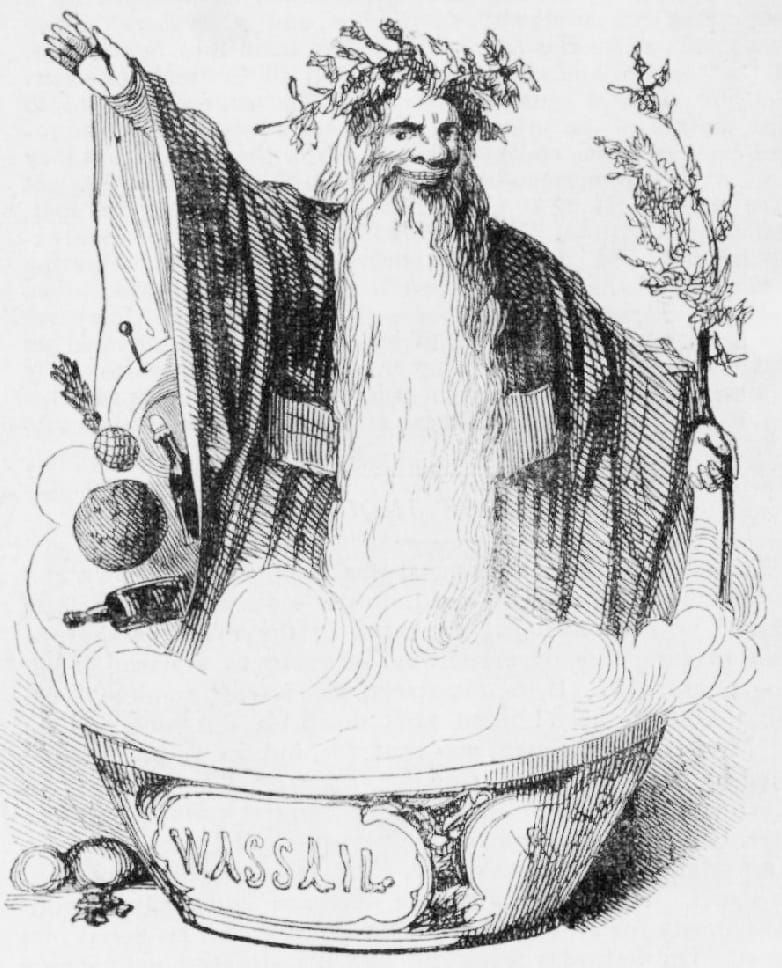
It's Friday, and the winter solstice looms this weekend — O sweet and snow-laden Jól, depth of darkness, the Holly King's revels! And despite being under immense, almost debilitating stress during this past month, which will unfortunately only continue after the holiday has passed, nothing has halted the promise of this Jól proving particularly magnificent. The reasons for my excitement are private, even occult, but I will at least say that I have felt a resurgence of enthusiasm about one solstice tradition that exemplifies the meaning of the longest night as the height of all things ecstatic and carnivalesque: communal seasonal singing.
As most if not all of you currently reading likely were raised in a Christian hegemonic culture, the notion of singing special songs at midwinter may evoke explicit Christian imagery or at least that uncomfortable grey area of "secular" Christmas celebrations wherein religious allegiances may not be expressed but there is still an assumption that everyone observes Christmas (see: the preponderance of secular Christmas pop music from the modern recording era). This may make such music uncomfortable, and speaking for myself I do absolutely abhor stepping into a retail establishment any day in December, since I'll inevitably be surrounded by that aggressive assumption in my ears, worsened by the fact that although some modern Christmas songs are objectively good, many are tawdry little horrors — and even the good ones are often covered in very dull or unpleasant ways. But when I'm able to choose the time and place where seasonal music is heard, and when there's actual communal input over what songs are chosen, then some very wonderful things can happen.
One of those things is the fact that in a pure musicological sense certain older, often more directly religious Christmas carols are very beautifully composed and I love to listen to their melodies regardless of lyrical content; this goes hand in hand with how despite my witchcraft, my animism, and my literal satanism, I've long harbored a complex syncretic approach to various tokens of Christianity, just as folk Christianity (especially pre-Reformation) has in turn syncretized well with animist traditions. But as I've already written periodically about topics like this, it's less of my focus this week. Instead, I'd like to highlight the other magic of this season's properly contextualized music — a magic that takes these forms:
- A seasonal singing tradition that even post-Christianization still points to music that may have constituted a traditional pre-Christian animist lifeway, not only around the winter solstice but also at other spokes on the Wheel.
- The powerful bond of ecstatic relation that arises between people whose voices have joined together in song.
- The energy that arises from combining 1 and 2.
And thus I am going to write today about the practice of wassailing, from its cultural history to my personal familiarity to my analysis of its importance.
Wæs hail: Germanic animist drinking & singing
Superficially, wassailing may appear to be nothing more than a more fanciful way of saying caroling, given that the practices both involve singing door to door, certain songs treated now as "carols" refer in their lyrics to wassailing[1], and modern practitioners themselves may freely conflate the two. To some extent this should not even be considered misleading; in the anglophone world there's obviously been historical continuity between wassailing, the progenitor, and caroling, the successor. However, it can be argued that caroling only refers to door to door singing through modern transference of that term onto what is still basically wassailing, as a carol itself comes from a medieval, francophone Christian framework of singing songs[2] to accompany religious mystery plays. So how does wassailing contrast with this, and what is its own origin?
To most succinctly answer that first question, I can say that the wassailing tradition is specifically English, and that while the lyrical content of a wassailing tune may make passing mention of secular-Christian events like Christmas or the New Year, as well as passing mention of "God," the overall thematic focus tends to be on asking one's hosts for alcohol, food, money, and/or good company, as well as wishing good fortune for this season or coming seasons. And in fact, while wassailing is now fairly exclusively associated with midwinter, English folk singing long featured door to door singing for other holidays (whether called wassailing or not) wherein more gifts might be sought and blessings bestowed.
But to fully understand what is called wassailing in this season, answering the second question about its origin reveals much more. As a word, wassail is a Middle English permutation of a phrase wishing "be in good health" that's found across a couple of older Germanic languages — either wæs hail in Old English, or ves heill in Old Norse that inserted itself into English through Viking Age settlement of what temporarily became the Danelaw. The Oxford English Dictionary seemingly favors the Nordic-to-English transfer, but while I'll defer to the professional etymologists' research it seems plain the eventual evolution of wassail has since thoroughly planted itself in the West Germanic cultural sphere, whether or not it started as North Germanic.
It is also known that functionally these phrases of wishing good health were first attached to drinking toasts, as we find with plenty of similar phrases worldwide. By the 1300s, though, wassail had also become a noun indicating the alcoholic beverage used for such toasts. This could be spiced ale, wine, or cider; the latter is what I learned to mull for this holiday about twenty years ago[3] and I suspect it's often what features lyrically in actual wassailing tunes because of how so many originate from Cornwall and the West Country where apples and cider form a major part of the local agriculture.
As for those tunes, wassailing became a verb for not only drinking toasts but also general merrymaking somewhere in the Elizabethan period, and from there the verb seems to have extended to an existing medieval or even pre-medieval practice among those Cornish, southwest English, and nearby Channel Islands communities, wherein people would drink to the health of their local apple trees and sing songs to them. This activity occurred around Twelfth Night, which as noted in other Yuletide posts of mine is (like the New Year) often the holiday for which various "Christmas" traditions originally developed before being shifted back up to Christmas itself once those other holidays were deprecated. Against the simultaneous backdrop of medieval peasants formalizing an exchange of singing for their feudal lord's generosity in winter, at some point the musical compositions for the apple trees cross-pollinated with the songs for one's "master," and by early modern times we thus find the wassailing tradition seeming strongest in all that apple country but also blended with ritualized begging.
It's only natural that from here, anglophone winter revelers would have thrown in more Christian holiday references to their wassailing over time; likewise it's only natural that as modern Christmas carols proliferated, these would have entered wassailers' repertoire and then in many cases supplanted it, inaugurating caroling as we now know it. But examining these roots tells an older animist story: wassailing is about the community relations fostered through sacralized, connective drinking, and it's also about the act of singing to the more-than-human world, and it's lastly about invoking the responsibilities of the haves to the have-nots.
Mari lywd: Celtic parallels by another name
While the word wassail might have been semi-violently imported from Scandinavian peoples to the English, it strikes me as likely that the drinking and tree-singing rituals to which wassail was applied were still English traditions in and of themselves; and given how the English (like many peoples) preserved many animist lifeways even after Christianization, wassailing in all its forms feels strongly animistic and might even derive from fully pagan practices. But most interestingly, while in turn the English were Britain's second round of colonizers after the Romans, I suspect that wassailing transferred seamlessly to Cornwall itself or emerged through contact with Cornish traditions[4]; I likewise suspect that further down the timeline, it's not a coincidence that modern caroling became and remains popular across all of Britain; and my rationale here is that Celtic peoples of Britain (and Ireland for that matter) have plainly had their own door to door holiday rites.
What I am most personally familiar with in this instance is the South Cymric rite of the mari lwyd, which has had some online trendiness lately that's only metastasized the existing lack of clarity around exactly how the custom developed or what it originally signified. But misinformation notwithstanding, the mari lwyd is indeed that horse skull on a pole, dressed in fabrics, ribbons, baubles, or what have you, and ferried from one home to the next by a crowd of revelers who at each threshold would demand entry and food through a spokesperson creatively improvising a song, which would be answered back by their potential host, who usually denied the visitors several times in essentially a singing contest until finally relenting. Why the mari lwyd was ever important to carry along for this process, none now know[5]; but this very mystery numbers among the factors for why despite the practice not being formally documented before 1800, scholars have routinely put forward the idea that the mari lwyd procession is in some way pre-Christian or an echo of something thereof — even if nobody can agree on what.
Other scholars put forward a conservative analysis that without clear earlier evidence we can surmise nothing and should instead look for explanations in why the mari lwyd would have arisen around the Industrial Revolution. I understand the reluctance to speculate too wildly about anything undocumented. But frankly I'm very sympathetic to the pre-Christian interpretation because I think when you consider the extremely macabre nature of parading an animal skull, and when you compare this with the extremely prim nature of 19th century Methodist-dominated Cymric society, I really do not know how that era of my ancestors would have spontaneously invented the mari lwyd. Now, maybe the mari lwyd is only as old as the medieval period itself, but then that would make it at least as old as some senses of wassailing, and that's interesting enough, particularly because of its own animistic qualities.
None of this would explain whether Britain's Celts loaned something to the English on the wassailing front, or vice versa, or traditions developed in parallel and gradually interwove through anglophone assimilation. But all told, I love just how much history there is to unpack in wassailing, and I would probably be fascinated by it even if I never actually had heard a wassailing tune in my life — if it were, perhaps, an utterly lost art.
But it isn't.
My step from caroling back to wassailing
I grew up singing modern carols — that is, carols from the Victorian era through the present day — with my family before my parents divorced. We wouldn't go door to door, though; we would just sing them at my father's piano together. And in our repertoire there were one or two wassailing tunes belonging to the caroling canon, but I didn't know them as such. I have many fond memories of these what these caroling nights did constitute, learning to stretch my then-untrained vocal cords and enjoy beautiful melodies while also listening to my mother's trained but age- and anxiety-dampened soprano, and my father's untrained, thin, but still pitch-perfect tenor. It was also occasionally awkward as my sibling and I encountered lyrics about the infant Jesus that we needed explained to us since it was an atheist household. One year, the two of us got inspired while singing to try acting out Mary taking care of Jesus in the manger, and this was roundly discouraged.
Of course I find this very funny now, but leaving those moments aside, it can also feel painful to remember singing together on those notes before my life was about to experience the ultimate familial rupture. If I hadn't experienced various better strokes of vocal luck, I might have come to associate holiday singing with a lost childhood that I could never recover. And on top of that, in retrospect I think that while there is no crime in singing holiday songs inside one's own home with only one's immediate family, it surely isn't the best use case, which I learned over time.
Deeper into my adolescence, I had done some choral singing in school or for music camps, and it had become apparent that while I'd inherited the stereotypical Cymric vocal gifts I was not so well-suited for the elevated classical choral stuff where one's voice is supposed to blend smoothly into a lovely but homogeneous shared timbre and volume with other people. My mother and I sensed I would be happier as a soloist, and even though an opera or musical career wasn't really in my mind, I gladly agreed to some private voice lessons that spanned both operatic and Broadway styles. And as I kept up with those lessons, mostly for recitals I sang alone[6] — until my voice teacher arranged for some of her students to form a small, ad hoc chorus to sing carols at a local retirement home. Through the songs she selected I developed a new appreciation for polyphonic singing while also finding that because we were all trained soloists we each let our vocal qualities exist on their own terms. And I really found myself loving the opportunity to sing traditional music with other people in a community setting.
Then I went to university and co-founded an a cappella group with a deliberately, even riotously eclectic focus. Given some of what we sang, namely barbershop/beauty shop quartet pieces, this did finally teach me a context in which I could enjoy singing with intentionally blended voices; but over time our membership also became invested in polyphonic singing traditions that didn't rely on blending, or that exhorted you to sing as loudly and ebulliently as you could. One of these traditions was Sacred Harp singing — and another was the wassailing tradition, as one of us was a budding expert on the subject and even on the musicological link between that and Sacred Harp.[7] And so in my senior year we traversed the campus wassailing.
And as I heard my then-mezzo voice carry the treble part for song after song asking for gifts and wishing good fortune, and as we walked between the dorms on snowy pathways with our breath fogging and throats needing constant hydration from warm fluids (also beer, although I can't say that's the best for actually singing), and as we brought smiles, bewilderment, delight, and maybe even slight annoyance to fellow students working on their December finals, and as the black starry night spun over and around us, I found myself caught up in something that felt much akin to the singing that the campus pagan group also conducted alone in our rituals. We wassailers had planned a purely secular activity, but the season had taken hold of me — and, I think, others — in a manner that could not be controlled.
I vibrated and crackled inside from more than the beer. I was in love with everybody walking beside me. I still felt the cold, but it was a subtle inconvenience at best. I did not have any purpose within me except to sing. The lyrics did not have to make sense (sometimes indeed they didn't); the harmonies carried the real meaning.
I have not been able to go properly wassailing again since that night seventeen years ago. First I lived in places where it would have been hard to really go door to door, and the best I managed was pulling together a group of comrades to perform some renegade "anticapitalist carols" (e.g. rewritten carols or outright union songs) in a commercial shopping district and mini-mall. Then that contingent crumbled, and I found myself eventually living in places where door to door wassailing would be very possible, but I haven't yet figured out which of my friends I could arrange this with. Lately I've at least been learning more and more about which friends of mine like to sing at all[8] but I have yet to bottom-line a wassailing project.
I probably should.
Wassailing examples
If you haven't heard that many wassailing tunes before, I'm going to link a few of them for you now. It's actually likely that you've heard at least one of these, the "Gloucestershire Wassail," since that's now in the Christmas carol canon. And in some of the others, the lyrics will be similar. But the melodies all vary, and the names are typically drawn from the part of Cornwall or England where the tune is known or imagined to have originated.
Wassail!
And now, hopefully with some of this music stuck in your head, I may wind toward the heart of today's post.
The ritual & evolutionary function of ecstatic music
To me, wassailing exemplifies ecstatic music in the sense that while the songs may contain wishes for fertile crops and abundance in the coming calendar year — and indeed my ecstatic/fertile dichotomy always contains each opposite inside of each pole — the act of singing this music is primarily about building sonic resonance between one's voice and the voices of ones' peers, connecting with one another through generating a sensory experience.
This is achieved on several levels at once:
- The basic audio-vocal pleasure of hearing live singing and joining in.
- The knowledge one is taking part in living animist history and thus subjecting oneself to the weight of centuries and ancestral ties (even if one is not descended from the first wassailers themselves).
- The lyrical centering of sensual enjoyment, i.e. good food and getting tipsy.
- As this is polyphonic singing, i.e. singing in harmony, there are the dual delights of either working toward a cohesive sound despite differing notes, or engaging in the joyous, low stakes competition to have one's vocal section (e.g. the bass section) stand out.
Ritually, thus, to wassail is to revel in one's bodily expressions and in others'; it is to lose oneself in a greater whole, both spatially and temporally; it is to embrace indulgence; and it is to play.
I am not surprised that neuroscientists, biologists, and musicologists alike have given attention to the evolutionary benefits of singing, for which there is a good article here, but which I can summarize as singing being intrinsically social, just like spoken languge, and offering a medium for processing complex emotions as a group, strengthening the group's bonds, and allowing for greater complexity tolerance in general. Here the science points to all singing, of course, and I know that all singing (and all music) is ecstatic on some level too. However, I feel free to extrapolate that where traditions in the vein of wassailing are concerned, this is where an extreme degree of relation-making and complex emotional space can be achieved because of the extreme sensory and historic immersion.
It is with this in mind that I now go into my own Jól weekend, and that I leave you to yours — but if you enjoyed reading this and listening to the songs included here, I hope it inspires you to perhaps consider going out for some wassailing yourself. And looking ahead to next Jól, if you're someone I know in person who feels inspired as well: let's talk further. The old tunes have been waiting.
[1] Such as the "Gloucestershire Wassail" ("wassail, wassail all over the town..."), featured elsewhere in this post, or "Here We Come A-Wassailing."
[2] Originally composed for a dance form known as a carole.
[3] My version with modern ingredients is cold-pressed non-alcoholic cider, simmered on a stovetop for a couple of hours with apple and orange slices, cranberries, cinnamon sticks, whole cloves, and powdered nutmeg, mace, allspice, and ginger.
[4] The Cornish people, lest we forget, are Celts who have simply been (perhaps) the most heavily anglicized, and not at all completely.
[5] Although the entity might habitually be used to chase people around in their homes, "snapping" at them, rather like the Obby Oss from Cornish May Day.
[6] I also sang vocals for a few acts in my high school's battle of the bands, but to my chagrin I was not able to actually start a real band or be invited to one. Unfortunately I may always harbor a bit of a complex around this.
[7] Unfortunately there was a falling out here, but not until after graduation.
[8] It's a karaoke situation.
I loved finally having the right timing to write this, even with an unseasonably warm air mass passing through to bestow strange wind and drizzle before we get proper winter again; and so I hope that you derive something good from it. I wish you a very good Jól as well.
Next week's post will be for Occult subscribers only, but after that I will probably be offering a public post on my limited but curious experiences with herbal remedies for respiratory symptoms — emphasis on symptoms — here in cold, flu, and covid season.


Member discussion