New Moon: The esoteric & the occult (Part II)
It's Friday, and the birds are becoming far more vocal, and taps are going up on the maple trees, but although our piles of snow had started to melt I'm now sitting through a fresh storm. Hello.
About six months ago, I wrote an introduction to the pan-Mediterranean esoteric tradition, planning for a two-part examination of what it really was and how my practices (much like those of most modern self-described occultists or pagans) partly sprang from it. Having now decided to write the second part, I'm now fairly certain that at least a third part will have to follow, based on the sheer breadth of what I intended to cover. Even making that calculation, though, I feel obliged to warn that with this series of posts I am in no way writing anything as comprehensive as what a trained, dedicated historian of this topic could offer you. Instead, I am only doing my best to contextualize the evolution of my rites, since I neither invented them in a vacuum nor inherited them from a lineage of people whose animist lifeways were wholly undisrupted and preserved from millennia past. The real story is less romantic but no less meaningful.
If you did not read the first installment of this tale, I would highly advise pausing here to read that instead, then proceed further. I am not planning to re-explain things like why I say "pan-Mediterranean" esotericism rather than "Western," or like the distinction I draw between the esoteric, the occult, and ceremonial magic. Some of these semantics may illustrate themselves in what I write next, but I cannot guarantee it, so please use that first post as a glossary of sorts.
But without further ado, let me now make some further clarifications about what I group under the massive umbrella of esoterica, and once that is out of the way I can finally start giving you the history of this esoteric tradition in my own words.
The esoteric umbrella
Previously, the terminology I defined was fairly high-level, essentially representing vast subtraditions and/or ritual tendencies. But what concrete, material stuff does the esoteric refer to at all? Any of us whose rites belong to or descend from the pan-Mediterranean tradition may have a rough idea of what I'm talking about without me needing to say anything, but I would prefer to speak as precisely and exhaustively as I can, so as to minimize confusion. It is not enough to use other placeholder language like "witchy stuff" or "woo."
Here is an incomplete but still quite long list of what I will call pan-Mediterranean esoteric tokens: they may be activities, objects of study, physical items, or specific ideas/principles. I am deliberately letting myself write this list as a stream of consciousness, without purposeful organization since there are too many different ways I could choose to group certain things depending on what my goals were. Think of:
- Alchemy
- Demonology
- Astrology, scrying, pendulum reading, tarot, rune work, palm reading, and virtually any other divination system practiced today by any significant number of anglophones or people strongly influenced by Euro-colonialism
- Spellcasting and other thaumaturgy
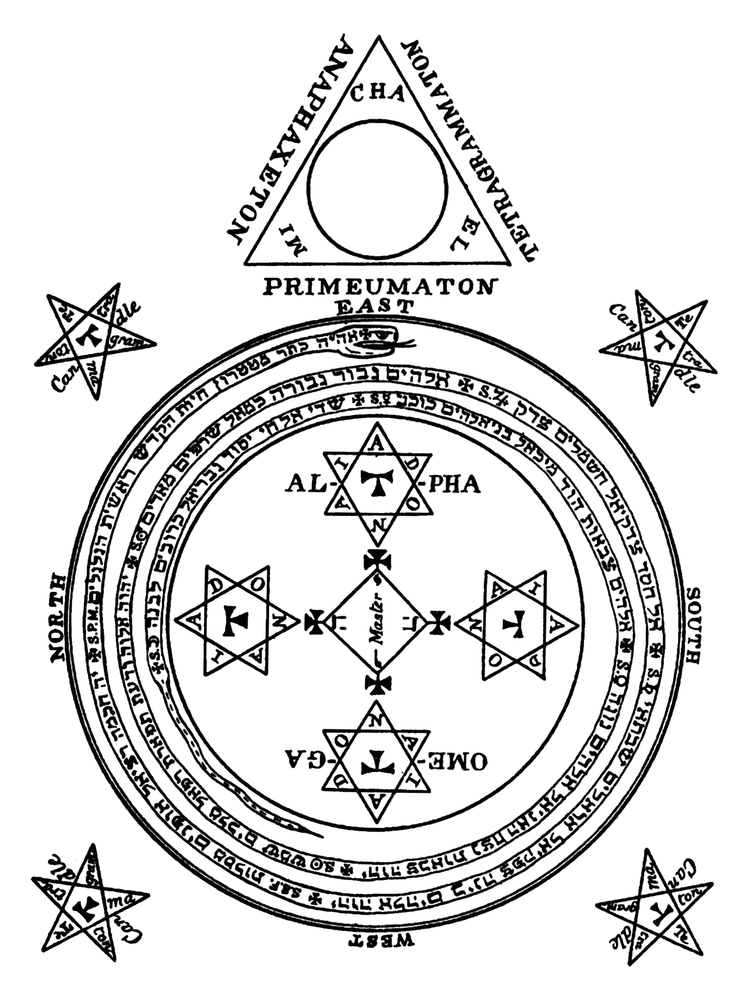
- Creation and dissolution of circular ritual spaces
- Pentagrams and other sacred geometry
- Ceremonial magic and its descendants like chaos magic
- Study of or reverence for ancient Egyptian deities, symbols, and lore, and likewise the same for Mesopotamian, Greek, or Roman equivalents
- Hermetic teachings
- Qabbala
- Sufism
- Crystal magic
- Worship of triple and/or lunar goddesses "retrieved" from the past, such as Hekate, Diana, or "the Goddess" of Wicca
- Worship of horned male deities "retrieved" from the past, from Pan to Satan to "the Horned God" of Wicca
- Use of the four classical elements
- Ritual attention to the cardinal directions
- Rites of invocation and evocation
- Gnosticism and other marginal offshoots of Christianity
- Grimoires and similar magical texts
- Magically aligned herbal medicine
- Spiritualism, mediumship, and paranormal investigation
- Sex magic
- Magic words or "words of power"
- Consecrated magical tools such as wands, knives, chalices, etc.
- Modern reinterpretations (and misreadings) of South and East Asian energy work and medicinal systems
- Initiatory societies like Freemason orders, the Hermetic Order of the Golden Dawn, and the Ordo Templi Orientis as well as other Thelemic (Aleister Crowley-inspired) cousin organizations
- Thelemic principles like "'do what thou wilt' shall be the whole of the law," or modified versions thereof
Some of you may have sensed that these are all related, especially if you are already a ritualist of some flavor, without necessarily knowing why; others may not have been aware of some connections, and you may not even recognize some things I'm referring to. Either way, many of these tokens do not belong exclusively to the esoteric tradition in question, and similarly it is unlikely that a modern ritualist engages with all of these tokens. And because there are esoteric traditions rooted beyond the Mediterreanean[1] I am also not covering those esoteric tokens except as indicated where pan-Mediterranean practitioners[2] have appropriated and spliced them into what we do. However, the tokens in the above list incontrovertibly have various temporospatial throughlines between them, many of which will be teased out in the history that I relay next.
The question to consider is thus not whether these tokens are connected, but what it means that they are connected. What are the implications? Is the esoteric basically a repository of any knowledge or wisdom rejected by Christian hegemony and then by secular rationalism? To what extent is the esoteric also interchangeable with "the exotic"? This last concern can very quickly cause headaches, since besides definitive modern appropriations like chakra work, many tokens mentioned above may seem like arbitrary, fetishistic borrowings from ancient Egyptian religion or Jewish mysticism, used under the same logic as whatever unfortunate mass-produced baubles we find in New Age stores; but the truth is much more complicated than that, embedded in the geography of very ancient cultural exchange.
So let's now look back.
Pre-industrial history
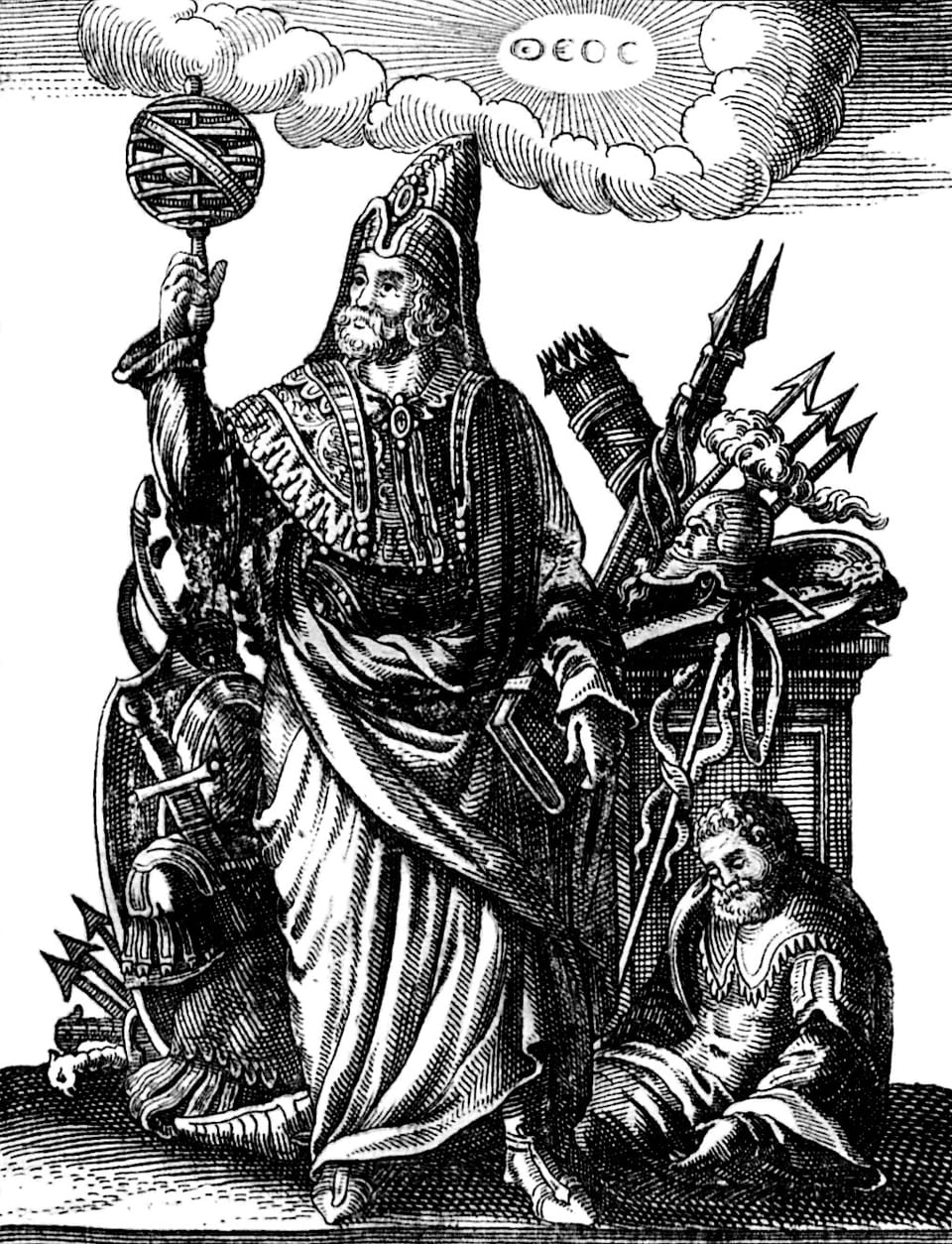
The pan-Mediterranean esoteric tradition is close to 2,000 years old, at minimum. That estimate is not the stuff of conspiratorial YouTube videos; it's an empirical, historical likelihood. The earliest texts considered part of the esoteric canon are generally from the 2nd and 3rd centuries CE, attributed to Hermetic philosophy that emerged in Hellenistic Egypt, Neoplatonic philosophy that emerged in Greece itself, and Gnostic Christianity that emerged in tandem with "regular" early Christianity across the Roman Empire. Each of these schools of thought was newer than Christianity itself, but if nothing else they comprised alternative knowledge systems from what Christianity would eventually impose[3].
It is more speculative for someone to venture that the texts from these schools contained once-widespread knowledge that belonged to peoples who lived hundreds of years prior to even that point. In many ways I'd say it's unlikely since as Prof. Ronald Hutton observes, historically the cultures of ancient Greece and Rome were rather hostile to magic as a distinct function from religion. Perhaps all the first known esotericists around the Mediterranean basin were countercultural from the start. Nonetheless, I would also buy in to the argument that due to the cultural contact with Egypt, whose ancient priestly religion did incorporate magic,[4] the magical practices that emerged in early pan-Med esotericism did not arise out of thin air and thus the tradition immediately incorporated some Egyptian magic of centuries if not millennia past. That's still just a guess, but I don't find it unreasonable, and I wonder what support could be found through other texts if the Library of Alexandria hadn't been destroyed.
Esotericism evolved further after late antiquity, integrating new cultural contributions. Just as literature like the Greek tragedies was preserved through the Middle Ages chiefly by Islamic scholarship, so too did that scholarship build esotericism outward, inward, backward, forward; the astrological and astronomical lore of ancient Babylon, if not already introduced through Egyptian sources, was cemented through Arab and Persian celestial knowledge bases that had grown therefrom. During the same medieval timeframe Jewish mysticism started to produce plentiful Qabbalistic texts, with Qabbala itself already having existed for centuries but now flourishing, especially in Spain and Italy; this period of Qabbala both drew from esotericism and fed back into it. Now the pan-Med tradition was incontrovertibly developing as an alternative to Christian hegemony, but this was happening equally through cultures untouched by that hegemony and those operating within it.
It is also worth reflecting here that while Egyptian magic and Qabbala alike would later be appropriated and fetishized in very real, unfortunate ways by non-Egyptian, non-Jewish occultists, given how much those magical systems form the early backbone of pan-Med esotericism it would also be disrespectful to purge legitimately exchanged Egyptian and Jewish knowledge from modern esoteric practices. The problem with these cultural elements in modern esotericism is not that they exist; they are actually foundational to what our esotericism constitutes. Instead, the problem is when Euro-descendant practitioners fail to stay in good relation with those roots — and fail to discern properly between the "right story" of those roots and the "wrong story" of later colonialist overlays.[5]
In any case, by the Renaissance in Europe we then find a very steady undercurrent of esoteric activities. Alchemists, already well-established elsewhere, now had a strong European foothold, and their path would eventually diverge between those remained "true" alchemists and those who laid the groundwork for the scientific "Enlightenment." They and other relatively urban scholarly types were devoted to textual knowledge preservation, transmitting magical instruction through hand-written or copied codices now known as grimoires, which could eventually be mass-produced and sold through the invention of the printing press. Meanwhile, for community healers, diviners, and similar magic-workers across the continent who had already syncretized pre-Christian animist knowledge with Christianized variants, these same grimoires became a popular means of enhancing one's skills; as Hutton observes in The Triumph of the Moon, the British community healers referred to as "cunning folk" had their known origins somewhere in this time, and despite their rural operations they were still often literate and had access to booksellers, libraries, or private distribution networks. When Britain entered an utter explosion of occult studies from the Elizabethan period through the English Civil War, it was not so much a matter of demonology or thaumaturgy being "rediscovered," and more a matter of spiritual pluralism voicing itself as the hegemony of the Church waned amid the Reformation and then Catholics and Protestants alike grew concerned with witchcraft; prurient interest in witches may have ironically engendered some desire to study what it was that they might know.
One thing led to another over the 17th and 18th centuries. Secret magical societies formed, such as the Rosicrucians[6]; and professional guilds freely integrated the esoteric into their meetings, which is what gave us the Freemasons. And the Freemasons in particular managed to spend centuries compiling an exquisite repository of practices that both preserved the esotericism that had come before and created the spoken and visual language that countless occultists would eventually take for granted.
All along, up through this point it would be hard to odd to characterize any kind of esotericism as also being animist, pagan, "nature-based," or what have you. Esoteric knowledge was by its very structure syncretic and cosmopolitan, not tied to any hereditary, indigenous knowledge system. While its openness definitely allowed for preserving various relational schemes that might have belonged to various cultures and landscapes, and while some animist mindsets could be very comfortable within it, the gods with which it concerned itself were usually not land-spirits, and the goal of prolonged esoteric study was more on the ecstatic side of my own ecstatic/fertile dichotomy. A practitioner of these arts sought transformation, self-actualization, deep wisdom, and so forth, unless they were one of the community folk healers integrating esotericism into their wider animist toolkit. Yet while esotericism's priorities put it at risk of turning into a decadent pastime for those with wealth and free time — and while this was indeed the case all too frequently — into the 18th century there was still just enough of a baseline quantity of communal land-connectedness even in Europe that it would also be a mistake for myself as a modern writer to describe those old practitioners as completely out of touch with biorhythms. They simply had to be, to a certain extent.
But then came industrialization.
Looking ahead to the post-industrial
This is where I will leave you for now; the third installment of this series can hopefully cover everything about the 19th century and early 20th century occult societies and movements that reflects a) practitioners' unique ecosocial concerns following the Industrial Revolution, b) the pitfalls that developed in esoterica during peak "hard" colonialism, and c) the post-Freemason, post-Thelemic tendencies that have sustained themselves both in consciously esoteric, occult traditions today and in neopagan traditions that nine times out of ten owe much more structurally to esotericism than they do to any surviving pre-Christian animist religion of Europe.
From there, it will probably become clear how my own rites formed, but I will still lay things out as deliberately as I can on that front. Hopefully it will not take me another six months to reach this conclusion.
[1] Prominently on the Indian subcontinent and across east Asia, but also formed syncretically through the Afro-Caribbean diaspora (e.g. Vodou, Santería, Candomblé).
[2] Often, though not exclusively, of a modern Euro-colonial flavor.
[3] Note that Christianity was not the official religion of Rome until the reign of Constantine in the 4th century.
[4] For example, citing Hutton's research again: creating a protective magic circle in order to perform a ritual is distinctively Egyptian in origin. This is not a modern appropriation, either; it has been directly transmitted across various magical systems around the Mediterranean basin since the practice began.
[5] Borrowing Aboriginal terminology through Tyson Yunkaporta's work, because I have never found a better way of phrasing this kind of problem.
[6] The Rosicrucian Manifestos of the early 17th century were one of those wonderful, impossible-to-corroborate projects that might have only been describing a fictitious organization but that managed to inspire the creation of real ones after it.
Thank you for reading and for bearing with this series' extremely slow release schedule, as it requires a particular degree of free time and mental energy. I would also like to thank those of you who support this newsletter monetarily; next week's post will be just for you, focused on individualist homestead ideology vs. intentional commune creation. The following week, public posts will come back as I wrap up my year-long zodiac series.

Member discussion