Full Moon (Zodiac Series): The mystic in art
It's Friday, and in this last season of the zodiac, I now intend to bring my twelve-month zodiac series to a close. Hello.
This will be a briefer post than many — especially briefer than the missive that paid subscribers received last week — but as the twelfth sign Pisces is concerned with the mystic matters of its ruling planet Neptune, and as we are in the week of the Full Moon, I wish to spend a few moments today reflecting upon the overlap between mystic experience and one particular Full Moon subject: art.
I care about the presence of the mystic in art because for one thing, art is one key method by which a culture propagates its underlying values; and thus if a culture's art is systemically devoid of the mystic or tends to represent it inauthentically, it suggests that the mystic is not granted serious importance. And for another thing, more personally speaking I find that good artistic representations of mystic experience can inspire new ways for me to better develop my ritual practices; and likewise, as a ritualist whose modalities of practice include devotional art I find it important to consider how I myself convey mystic "content" in the art that I create.
So with this in mind, I am going to offer a few small observations and questions for your weekend.
What the mystic is
I have not spoken much of the mystic by that name in this newsletter. I speak more of the esoteric or occult, which are varieties of knowledge, with -isms referring to schools of thought or lifestyles built around such knowledge. I also occasionally speak of the sacred, the divine, and animacy, all of which are qualities of things we encounter, as well as qualities that exist within ourselves. But while that which I call the mystic overlaps and relates heavily with all of these other concepts, it is not perfectly synonymous with any of them.
No two philosophers, psychologists, or scholars of religion will agree on a definition of the mystic, either, but I will use some parameters outlined by one of my preferred thinkers, William James. These standards are not necessarily the only ones I would choose, but they are suitable enough for today. The mystic is a category of conscious experience notable for being:
- Ineffable (unable to be fully described with language)
- Noetic (belonging to the realm of the mind, both in the sense of offering deep knowledge about reality and of not being reliably measurable beyond one's conscious perception)
- Transient (usually not lasting perpetually, since most people can draw a line between mundane and mystic events)
- Passive ("happening to" the person who experiences it, rather than being something they actively induce)
With such a broad framework, a great many experiences may qualify as mystic, but they are most likely to be alternately described as supernatural, magical, spiritual, irrational, psychotic, or as mentioned already, divine. They carry something within them that is not explicable by purely material science; whether or not you can think of a scientifically measurable cause, the experience itself manifests as something immeasurable.
A note about the last characteristic of mystic experience as passive: I could see someone disagreeing with this adjective choice because it would appear to contradict the legions of people throughout history and the present day who have actively pursued altered states of consciousness through drugs, meditation, dance, or what have you. In other words, since my one fully intentional psilocybin trip gave me precisely what I would call an encounter with the mystic, I have to ask whether the Jamesian definition of the mystic would disqualify psilocybin use. However, even leaving aside the very fact that James appears to have used at least some drugs experimentally as a Harvard academic in the late 19th century[1], I think we should interpret "passivity" as having little to do with the means by which the mystic experience transpires, and more to do with whether the experiencer can really control the onset, content, or dissolution of the experience. In this respect, while anyone can choose to take drugs, meditate, dance, etc., if a mystic experience occurs it still fundamentally descends upon them in the manner of a dream.[2]
In any case, because the mystic is transient, if we wish to represent it in art then we can at least easily manage to represent the divide between that which is mystic and that which is not. And because the mystic is noetic, it's also highly tempting for anyone of a certain personality — and many artists have this personality — to try conveying the knowledge, ideas, or awareness that a mystic experience carries. Are these not the things that some of the most powerful art should probably be made of?
But because the mystic is ineffable, herein lies the challenge. How can we ever accurately represent a fictional version of the mystic even from a first person point of view, let alone in the third person, without just conjuring the mystic itself?
Representing mystic vocabulary
It seems to me that for many artists, whether they're painters, writers, filmmakers, or any other possibility, the most obvious and straightforward approach to creating a work of art that conveys the mystic is, well, to employ images and narratives that literally depict mystic occurrences. This could involve an endless array of classic storytelling tropes, with or without belonging to any specific genre. Just a few options might include:
- A story, whether visual, textual, or musical, with a character who has a divine vision, encounters a supernatural being (ghost, fairy, monster, etc.), or something else that's diegetically[3] out of the ordinary
- A work of art, narrative or otherwise, that by the creator's own explicit admission (or indication within the work) conveys sensory qualities of a mystic experience they've had at random or through certain means, or an experience they're relaying from someone else
- Going a step further, perhaps the entirety of all fantasy/supernatural media wherein divine, otherworldly, or magical beings and/or alternate planes of existence and/or people who use magic are depicted, insofar as these things may be more apparently "real" than they would seem in other genres, but they still belong to the substance of what people in modern consensus reality typically consider unreal — and thus only "really" encountered through mystic experience
I refer to this kind of art as art that uses mystic vocabulary. And mystic vocabulary is wildly popular. In modern filmmaking and television, it's covered everything from the Ark of the Covenant melting Nazis' faces to high school students hunting vampires, or from epic sagas about wizards and dragons to the entire horror ecosystem of haunting as metaphor for trauma/grief. If we think of painting or sculpture that conveys the mystic, it's often similarly concerned with fantastic or surreal themes, or it may attempt to reproduce the kinds of hallucinations that people have on entheogenic drugs (i.e. psychedelic art) or during psychosis. Music may have lyrics about strange visions, such as the retelling of a Wild Hunt in country classic "Ghost Riders in the Sky"; poetry and prose fiction alike have long relayed the dealings of gods, spirits, sorcerers, or tried in their own way to deliberately convey altered states of consciousness.
While I'm very partial to lots of art that uses mystic vocabulary, however, I believe that this approach has limitations. For every work of art that I think adequately conveys a sense of wonder, magic, sacredness, divinity or any other noun on the mystic palette, there are many more works that fail. This failure can stem from the creator just lacking skill; but for a long time and especially over the past few decades of last stage capitalism, I think the more common issue is that the people who own the means of mass art production are not even pretending to care about anything that specific artists create beyond the art's perceived marketability. And because the mystic is ultimately ineffable, simply slapping a glowing phantasm on the silver screen does not in any way guarantee that the imagery will even come close to approximating what it would actually feel like to see a ghost. It doesn't even help if you try to systematize the hauntings or the magic and feed me that logic through exposition; if anything, I'm going to dislike the art more.
This basic challenge is the root of why I love how the supernatural is portrayed in Twin Peaks whereas I've never given two hoots about the Harry Potter empire.[4] It's also why I do still love some highly accessible storytelling like what Spielberg manages for Raiders of the Lost Ark or what George R. R. Martin has been handling in slow motion for his A Song of Ice and Fire series[5], but I admire these works for the storytelling itself more than as transcendently valuable depictions of the mystic.
Using mystic grammar
With some exceptions, I am often less interested in what art depicts than in how it depicts that thing. Accordingly, I think that some of the best portrayals of the mystic in art are successful because they use what I will call mystic grammar, often relying on distinctive traits of their materials, structure, or ways of arranging ideas within that structure. What could make their traits distinctive may be that they are decidedly unusual, or it could be that they are more "normal" but still carefully chosen to provoke a sense of the uncanny in the audience.
Such art typically loses accessibility by modern mass media standards, being regarded instead as experimental, weird, and potentially self-indulgent. Of course, sometimes there is crossover appeal to a large audience — take the director Christopher Nolan, whose films are fundamentally "just" blockbusters in sensibility but whose nonlinear narratives periodically convey ideas, moods, and perspectives on a more profoundly meaningful level than many of his contemporaries with the same financing. But ultimately, I do find that mystic grammar is easier to find in art that's made orthogonally to capitalist enterprise; and while egos can complicate whether art is really being made "for art's sake," if someone is focused more on mystic grammar than on mystic vocabulary I think their art is going to be more successful either way at rendering mystic experience.
Sometimes if an artist is working with mystic grammar, they will also incorporate that vocabulary, but it's not strictly required. Here are just a few artists or specific artworks exemplifying mystic grammar.
- Nearly all of David Lynch's filmmaking and paintings
- A Field in England and In the Earth (dir. Ben Wheatley, 2013 and 2021 respectively)
- Beyond the Black Rainbow (dir. Panos Cosmatos, 2010)
- Enys Men (dir. Mark Jenkin, 2022)
- Solaris (dir. Andrei Tarkovsky, 1972)
- Suspiria (dir. Dario Argento, 1977)
- Darkwave pioneers Dead Can Dance
- Experimental noise band Menace Ruine
- Certain albums by Nick Cave & The Bad Seeds like Ghosteen (2019)
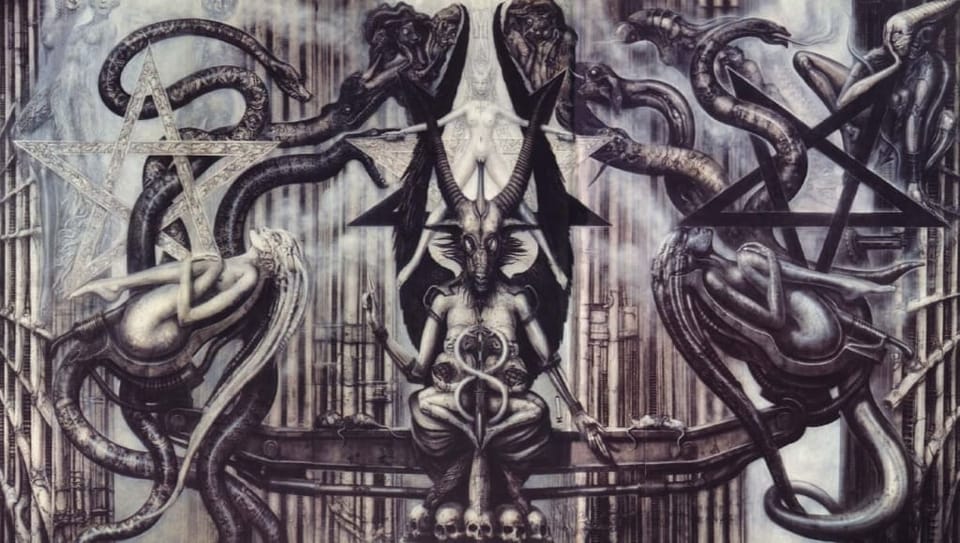
- The art of H. R. Giger
- The poetry of William Blake
- Certain works by Ursula K. Le Guin like The Left Hand of Darkness (1969) and The Lathe of Heaven (1971)
Since I doubt anyone reading will likely know all of them, I should note that they occupy a spectrum. Some have mystic vocabulary all over them, and others nominally concern themselves with very mundane subjects but use mystic grammar so prolifically that the mundane is turned mystical. Many are somewhere in between, including work that would be classified as science fiction and therefore seem more empirically minded on the surface, but that veers mystic through the storytelling techniques. Unfortunately, you may notice that male artists are overrepresented here, but this is hardly a matter of my personal taste; it speaks instead to how as hard as it is for "unusual" art to be successfully produced and distributed, it's even harder if the artist is not a man.[6]
Without simply sharing extensive samples of the above work with you, it is naturally complicated for me to explain how or why any of these satisfy my concept of mystic grammar. But I would say that certain qualities in common between many or most of them could at least be summarized as a) an unwillingness to explain (or at least over-explain) anything extraordinary that's depicted, b) transcendental images, lyrics, or stories, and c) the prioritization of sensory texture and at least some openness to pure abstraction, which results in the possibility of ineffable experience for the viewer instead of merely transmitting didactic information.
Mystic grammar is, at its core, a willingness to make art weird — because of knowing that there is more to learn and explore in weird places.
Dissolving the boundary between the mystic and the artistic
But what if art could go further? For indeed, some art does.
Anthropologists and art historians have rightfully speculated ritual functions for some of the oldest known art, and I say rightfully because while in many cases the functions are pure speculation, in some cases we do know that the art's creator(s) did make the art for ritual reasons, and we cannot rule this chance out in plenty of other instances. One definitive example of this tendency is Greek theatre. It was fully theatre as we in Euro-colonial modernity would recognize it, even with certain characteristics that a lot of our theatre has jettisoned[7]; but it was made explicitly in service to Dionysos, to be performed in his honor.
With that history in mind, I find very fertile ground in the possibility of wedding mystic vocabulary and grammar tightly together in art, concentrating and distilling them such that the art would likely become a focal point for actual mystic experience — whether for the people making it, or for the art's audience. I know this, too, is not new; there are countless artists in certain musical subcultures who speak of their concerts as rituals, or there are films like those of Kenneth Anger that were openly made with ritual intent and would easily qualify as the most mystical cinema I've ever seen. I am aware of many hyper-niche and even non-professional artists at one, two, or three degrees of separation from myself, who essentially conduct or arrange group activities that straddle the line between ritual and performance art. But for all my own devotional ritual art, I personally feel like I am only just beginning to understand how to share that art with others, or collaborate on it with people besides my owner.
So this is where I'm going to let the topic rest — as I ask which mystic artists my readers would recommend on this front. I am curious where our tastes might overlap.
[1] Nitrous oxide being one of them.
[2] This is an imperfect comparison since some people of course can lucid dream. But in turn, some people who pursue personal transcendence or enlightenment through meditation (for example) have a degree of controlled focus in their meditation technique, which might be compared to lucid dreaming. In cases like these, I would say that if perfect lucidity and control remain, then I think the mystic's "passive" requirement has to falter a bit. However, I would freely give a casual estimate that for every person whose mystic experience is at least somewhat within their power to control, there are at least ten people who find that the mystic just happens to them, whether or not they initiated some process that would invite it.
[3] In filmmaking terms and I believe also in wider art criticism, anything diegetic is something that belongs to the actual universe of any story taking place, such as music coming from a radio. Something in the artwork is non-diegetic if the audience may notice it but any observers within the story do not, such as music that belongs to a soundtrack. There is obviously some room for humor here, as some artists exploit this creatively.
[4] Long before J. K. Rowling became a 24/7 public transphobic meltdown, her writing was just very insipid and pointless.
[5] Or the first three seasons of its TV adaptation. We will not discuss the rest.
[6] And it isn't as if men don't dominate mass market media as well, with the exception of certain unfortunately pigeonholed "women's content."
[7] Such as all characters wearing masks, plotlines obeying rules of timespace unity, and violence generally happening offstage.
Thank you for reading and especially for accompanying me on this idiosyncratic journey around the zodiac over the past year. I hope that the remainder of this Pisces season offers you some special chance for (spi)ritual growth.
Next week, I will have some thoughts on near-death experiences, and the following week I will have a gleefully blasphemous holiday post for Ostara.

Member discussion