First Quarter: Respiratory remedies (with disclaimers)
Hello. It's Friday, and as we are in the very thick of winter we are also going about our lives amid the greatest seasonal risk for respiratory illness. Having already been sick for the first half of December with what was probably influenza despite vaccination, I am hoping I can at least avoid any colds for the rest of these cold months — and of course, having had covid once, I would strongly prefer to never catch that again.
But at this time of year, such concerns do mean that right now when I turn my mind to matters of hedgecraft — which does not exclusively involve herbalism and plant magic, but which heavily centers around these — I find myself deriving some comfort from my increasing awareness of life forms who have evolved in tandem with humans and helped us take care of ourselves when respiratory disease strikes.
Yes, by every reasonable empirical metric I do accept the conventional wisdom that before modern pharmaceutical medicine, people died more often from such illnesses; even while antimicrobial properties exist in various fungi, plants, and minerals, there are refinement processes offered by modern equipment that allow medicines to stand a better chance of healing higher-risk bacterial or fungal infections, such as when pneumonia arises from a cold. But besides the problem of antimicrobials (especially antibiotics) now also being overprescribed, disrupting our gut flora and incentivizing resistant microbial strains — lately I think it's also important to consider how the most common respiratory diseases are caused by viruses, which may these days have vaccines or other interventions but for active infections usually receive treatment for symptoms and not antiviral drugs. (Covid is a notable exception.) In older or current non-modern societies where the herbal treatment options would at least stand a fair chance of improving symptoms if the right plants were used, how much would one's experience of the average common cold differ between now and a thousand years ago, other than in how one's symptom relief was administered?
That's a difficult question to answer, and since I'm neither a qualified historian nor a legitimately trained herbalist I should probably not try to explore an answer at all. Nor can I make a fair claim that herbal remedies to respiratory illnesses were either more or less effective than what we are usually taught. But in fairness to both modern and anti-modern positions I must point out that given how viral infections are not always self-limiting, treating symptoms alone is not always enough. And thus pragmatically speaking, unless you have substantive knowledge and resources around truly curative herbs I will always say: when in doubt of how "mild" your illness is, please consider taking the pharmaceuticals that have helped you before, because you're no good to any radical dismantling of the medical industrial complex if you're already dead or if you can't function how you need to.
But what I do want to write here this week, regardless, is a small review of a few plants with whom I have experimented a little bit as remedies for respiratory symptoms, or whom I keep on my radar so to speak — because I do like having them around as an option in order to support degrowth principles, collapse preparedness, land connection work, and so forth. And before I get to discussing those specific green friends, I also need to problematize and complicate several things I just said above, in order to refresh readers' understanding of why my witchcraft keeps pointing me toward herbalism despite disclaimers.
First: why are the disclaimers so important?
I am a genuine pedant about many things, whereas I feel much more agnostic about the efficacy of herbalism; if anything, for reasons I'll elaborate on in the next section, I think that what "we" (modern Eurocolonial society) do not know about historical herbal medicine is likely to be information that would indicate such medicine is more effective than we imagine. But saying this may seem at odds with having just advocated for most people to rely on modern pharmaceuticals as a general health precaution. So why am I hesitant to offer herbalist reflections without including such warnings?
The answer is not comfortable, but it is straightforward: most modernized Eurocolonial people do not have access to indigenous ethnobotanical knowledge about their local herbs, and capitalism has taken full advantage of this fact. This means that when our population researches herbal remedies, there is an extraordinary amount of utter decontextualized horseshit being served to us. Most of what we find is what an industrial manufacturer or distributor wants us to read, or what a solo grifter (witting or unwitting) has said for views and clicks, and this is to say nothing of the internet exploding over the past few years with robo-slop. Leaving aside the knock-on effects of certain sacred herbs being unethically sourced and disappearing from where indigenous communities rely on them, in general a full-bodied but careless dive into herbalism runs the small risk of poisoning oneself — and the much more significant risk of using herbs that do not remotely work as advertised. The herbs may not actually contain useful compounds for that given purpose; or they may have weak potency because they were not sourced with any quality controls; or they may be advertised as "curing" a disease completely when they're only useful for symptom relief.
And if you take any medicine whose efficacy is compromised or nonexistent, the placebo effect may help you regardless — but it's a distinct gamble to take that medicine to the exclusion of any others. Depending on your ailment, it strikes me as common sense to incorporate drugs with peer-reviewed studies supporting their efficacy, provided that those drugs are otherwise compatible with your personal health profile. I gently but seriously urge most people to not give up modern pharmaceuticals completely just because they think they've found reliable traditional methods. In my opinion, if you have not studied for years in an indigenous ethnobotanical context or at least through one of the few rigorous postcolonial herbal schools out there, then I suspect you have not found one of those reliable traditional methods.
This does not mean herbalist experimentation is not worth attempting. It just means such experimentation is not an immediate substitute for Big Pharma.
And now let me problematize and complicate, as promised.
Second: "just take the damn Tylenol" and other unfortunate concessions to capital
When making disclaimers in an herbalism discussion, what I do not like doing — and try very, very hard not to do — is to capitulate to a particular sneering skepticism that usually accompanies other settlers' logic around traditional indigenous/folk medicine. These skeptics work from elementary assumptions that rely on capitalist, colonialist, imperialist worldviews, taking for granted premises such as:
- That modern industrial medicine has an unwavering commitment to actually curing disease;
- That modern pharmaceuticals always achieve their promised effects, and their negative side effects are always worth risking;
- That modern pharmaceuticals are never scams in their own right, or have never been used maliciously on disenfranchised populations;
- That any negative ecological consequences of industrially manufacturing a certain drug are inherently justified by the public health benefit;
- That it is possible and desirable to build a society in which all serious illnesses are eliminated and all "nuisance" illnesses go away as fast as possible.
In contrast, while I am sympathetic to why someone would think these things, and while I would say some of these premises are half-true, a more comprehensive and mature view of history, politics, and ecological ethics ought to highlight for us:
- That modern industrial medicine has an unwavering commitment to treating disease insofar as drugs can continuously be sold for profit under the auspices of symptom relief or progressing recovery, but curing most diseases is out of the question because there is money in letting something like cancer continue to exist, and even in avoiding mass vaccination[1];
- That modern pharmaceuticals absolutely do fail for some people who take them, and some of their negative side effects are absolutely worth avoiding;
- That modern pharmaceuticals such as oxycodone have been pushed by their manufacturers and fomented horrific public health crises as a result, or that clinical trials for certain drugs have been used to horrific effect on many humans;
- That we can perhaps simultaneously allow for pragmatically consuming a coal tar derived drug like acetaminophen, and advocate for finding alternative synthesis methods that do not rely on fossil fuel extraction[2], and work to transition toward localist, community-level microproduction of equivalent herbally-sourced antipyretics and analgesics;
- That it is not ecologically or cosmically sustainable for any species to render itself immune to all microbial checks on resource consumption... and that in a more just society where selling one's labor was not a requirement for staying alive and having basic human rights, mild illnesses could take as long as they needed to resolve because the right to rest and recovery might be held sacrosanct.[3]
Given the basic survival choices that I do have to make and the disclaimers I've already offered, I cannot exactly opt out of modern industrial medicine altogether. And given the existential threats and gratuitous suffering posed by various disease, I am certainly in favor of trying to develop more vaccines; being seriously ill much less often is good. But when contrasting the efficacy of herbalism with what some people call "real medicine," I think it's crucial to call attention to these reasons why it's not necessarily "real" medicine, or why (whether real or fake) said medicine does not merit our worship.
Furthermore, the very greatest assumption of all remains: that modern pharmaceuticals do statistically save more lives and provide more effective treatment than any herbs do, have, or might. Like I said already, I am not in a position to review the breadth of pre-modern history and offer any useful thoughts on this front. But while my urge to avoid playing into wellness grifter logic tells me to say, "The data we do have shows that average life expectancy utterly skyrocketed once some humans started operating off of germ theory and relying on modern industrial drug fabrication" — and it did skyrocket — I do not want to offer that statement with any smugness, and I will even risk offering the counterpoint that this demographic data seems to be largely a comparison across early modern vs. recent modern populations. In other words, naturally less people in capitalist economies die now from disease than people in, say, 17th century England where traditional ethnobotanical knowledge was in the process of being stamped out with nothing effective to replace it.
To some extent, where indigenous populations outside of Europe are concerned, I do feel compelled to defer to their own testimonials about their traditional medicine, which in my experience are often along the lines of that medicine providing good preventive care and symptom relief, meaning that many illnesses were uncommon prior to colonization and the remaining illnesses were at least psychologically endurable when they didn't turn deadly. How accurate this collective memory is — that's not my business to analyze or comment upon, neither in a critical nor fetishizing way.
But to conclude my thoughts in this vein, I keep stepping slowly into herbalism because despite all the pitfalls of doing so as a witch who herself has not directly inherited an ethnobotanical tradition, I at least know that I may find some medicine that's just as effective as the pharmaceutical version in certain regards, thus allowing me to concede less to capitalism. It is worth taking advantage of whatever opportunities do exist for us to throw off such shackles, even if exact time and resources and capacity vary by individual. It is worth developing a closer relationship with the land through intentional symbiosis, and one means of that is to cultivate stands of plants we can visit for food or medicine alike.[4] And by "it is worth," I mean that the earth needs us to try, and so do our own selves.
Third: entering herbalism with care
My approach to trying herbal remedies is essentially to emphasize that verb, try. Try plants for certain purposes in small amounts, seeing what the dose should actually be, making sure there's no allergic reaction or unpleasant side effects. Try plants that I can ideally monitor myself to gauge potency, or that at least have been gathered by someone in my own ecoregion who might take similar care. Try plants without expectation of them doing anything, and especially not miracles. Try plants with an ethos of risk awareness, knowing that even though it's the responsibility of knowledge-compilers to avoid misinformation, at the end of the day I am responsible for whom I choose to trust and what I decide is safe to attempt.
All of this is important with regard to other wildcrafting activities like foraging, but I think it bears special attention if we want to use plants medicinally, because with medicinal plants we can rely less readily on basic wisdom like, "If it tastes bad, it's not safe." Many herbs taste very strong and may be off-putting depending on their administration method. Similarly, although we do eat many herbs in or as our food, when using them medicinally we may consume or absorb a larger amount than we would normally eat, so side effects (whether annoying or dangerous) may be stronger.
When I try out a medicinal herb these days, even when I'm 100% certain of its identity I double- or triple-check what kinds of side effects or contraindications I might want to be careful of with my unique health profile. Only once I've reminded myself of that information and determined compatibility do I proceed. Then I will start with a tea because it takes less time or supplies than a tincture, decoction, etc.
Depending on the herb, I may try it intentionally while I'm not sick, because I might not want to risk it making me feel worse; but I may also wait to try it until I am sick, because the intended effects might not be worth inducing otherwise. (There's more about this in some of the herb reviews below.) Whatever the case, I sip the tea slowly and pay close attention to how it makes me feel. If it makes me not feel very well, although this hasn't yet happened, obviously I won't try it again, especially not without figuring out the reason. If it doesn't seem to do anything notable but tastes pleasant, I will maybe try it again some other time, sporadically. If it exhibits some effect like what I had researched and I feel good or better, I will also maybe try it again in the future, if the context seems appropriate.
What I have yet to do and probably will never do is start instantly drinking the same herbal tea every day just because it seems safe and is supposed to have long-term health benefits. For one thing, toxicity can build up slowly. For another thing, it seems much more sensible to rotate between various herbs as "maintenance" medications, not just hammering oneself with the same thing over and over.
That is my herbalism strategy so far. And now, having spent close to 2700 words on prologue, let me finally and in all likelihood more briefly review the respiratory remedies I've kept or wanted to keep close in this season.
Herbal respiratory remedies I've been exploring
Here is one last disclaimer: you will notice throughout this section that although I explain why I have tried these medicines, I have not phrased anything as a recommendation other than possibilities for how to prepare the item in question. Not only am I no expert, but also I do not constantly experiment with these herbs (or any herbs) and so I consider even my own anecdotal observations limited. I will reference existing plant lore, but I will clearly delineate that it is something I have read or heard, and not something I authoritatively know.
I share these experiences not to teach, but rather to praise these plants with whom I am forming a relationship.
Honey
Of course, this is not an herb in that it is not a plant. But it is often included in the traditional medicine I've encountered, and I had to start with it here because it's probably one of the first such medicines that I ever remember using: my mother would give me a spoonful of honey in the morning if I had an illness that involved a sore throat, and sometimes she would also mix honey into a cup of tea for me instead of granulated sugar. To this day, I will often eat some honey for throat-soothing, and I will make sure it gets into some tea when I'm sick; frankly, it's also my preferred tea sweetener any day of the week.[5]
To some extent, I consume honey in this way because its antimicrobial properties have been documented relatively well in not only folklore but also scientific literature. I have never really noticed if it helps a sore throat go away any faster for me, though. I think it's enough that honey's consistency eases that raw, ragged sensation, and its sweetness lifts my mood.
Whenever possible, I try to get honey from my household's favorite local producer, and depending on the flavor this producer offers some honeys from their very own bees — so, local bees. I do not personally go in on the rumors about honey from local wildflowers assisting with seasonal allergy resistance, because the plants that cause allergies are releasing their pollen on the breeze, whereas the plants that bees pollinate are, well, pollinated. But supporting local apiaries seems like a relative good, and connection with local wildflowers is also good.[6]
And indeed, although I must thank the bees first for their honey, the honey comes from flowers, and so I thank all the flowers who give to the bees, and who give to my sore throats by extension.
Mint
This is the one respiratory remedy I grew up with that's also really a plant, although I experienced it in an industrially processed form. I was told that the menthol in a chest rub ointment would open up my asthmatic airways during my frequent childhood colds and bronchitis. I did find it effective. The mechanism was clearly not from the ointment absorbing into the skin of my chest, but rather from having the menthol vapor close to my mouth and nose, so I'd be breathing it in all night.
I haven't tried that exact formulation in twenty years, but I would like to try making my own peppermint ointment with a more sustainable base than the commercial petroleum jelly. I suspect it would feel very nice; I thought about it a lot when I was dealing with bronchitis again last month. Mostly, though, I have drunk mint tea for various ailments, not all of them respiratory — but when mint tea and honey are combined together, I find the effect on my throat is especially wonderful.
If I run out of our supply at home, I just buy mint at the store, but generally speaking I've tried to garden mint for years. Ironically, while mint has a reputation for taking over, the spearmint in our herb bed is in fact poorly situated for adequate sunlight so it doesn't grow that abundantly and takes a while to return each spring. But it's still a stubborn little perennial of a kind, and next spring I look forward to making some changes that will allow for much, much more mint — probably multiple species and hybrids. Some mints do become invasive, but most seem to naturalize well, and our local pollinators like carpenter bees seem to love their flowers.
Thank you, mint, for your cooling kindness.
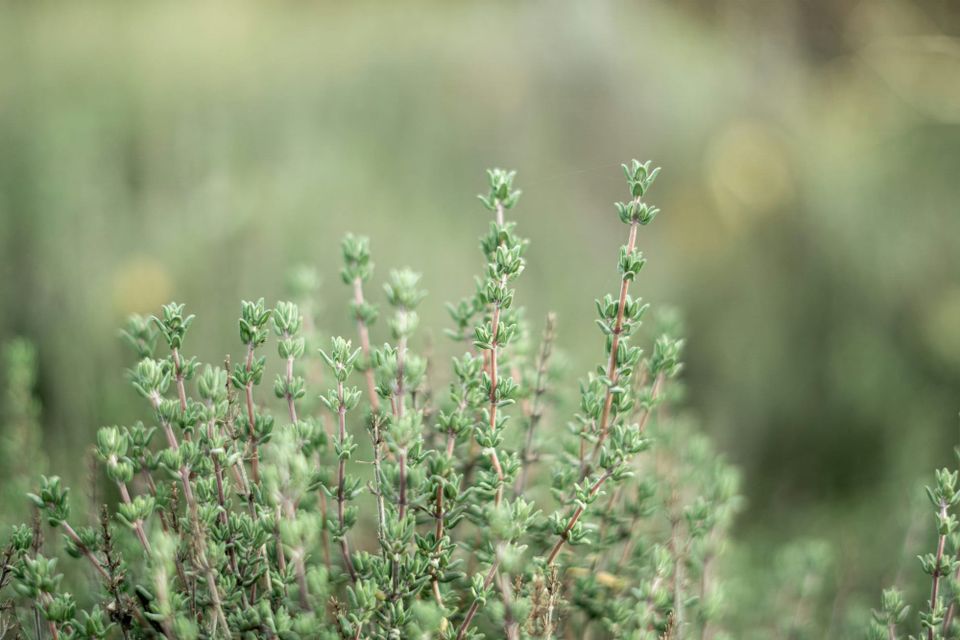
Thyme
Although I had read several times about thyme's purported medicinal value, I will credit a fediverse friend with convincing me to try thyme when I had not only a sore throat but also a very unpleasant cough. Supposedly thyme has compounds that have an antispasmodic effect, and given that I love the flavor of thyme in food I decided to try it in the careful tea-brewing fashion described above. This was several years ago.
What I found with my thyme tea was that it tasted very interesting and certainly made some difference. I remember that my cough improved for a decent part of the day after drinking it. However, the tea did make me feel slightly dizzy — not dangerously so, but sort of in a "hopped up," faintly psychoactive way. I have since drunk thyme tea one or two other times for comparable coughs and was thinking about it last month, but I would not drink it on a routine basis. I'd sooner have a cup while sick and then have a long lie-down.
Like mint, there is thyme growing outside in the garden, and it's very successful here. It's actually rare now that we ever have to buy thyme somewhere else, especially since thyme is an herb whose potency benefits from being allowed to dry instead of being consumed fresh. Our thyme plant is almost a small bush at this point, and the local bees love the flowers, and some songbirds or chipmunks must love the seeds because I find errant thyme patches occasionally cropping up elsewhere on our plot.
I am glad that this being is relatively integrated into the place where we live, and I thank it for whatever strong, special medicine it does seem to carry.
Yarrow
I have yet to grow yarrow myself, and oddly enough I haven't even found a forageable population nearby. But I have a packet of dried yarrow heads from a sustainable semi-professional forager in the same ecoregion, and I have kept this packet around for such occasions when the anti-inflammatory properties I've read about might come in handy.
This occasion arose last spring when I had covid. Although I did take acetaminophen and ibuprofen fairly regularly along with ondansetron for the nausea I experienced, I felt so laid low that I could really have used any possible assistance in making sure the illness didn't get out of control. Considering how long I had some lingering effects from the virus anyway, and considering how I might even still have one or two effects now, I am not sure how much the yarrow or any other medicine exactly did for me, but by the same token I can only wonder how much worse I would have fared if I didn't use any of those things.
With the yarrow, I brewed tea several times during my illness, both for myself and for my owner. I noticed it tasted wonderfully sweet and bright, and it seemed to help ease some of my feverishness and brain fog. Even if that's all it did, it was a small mercy.
Thank you, yarrow, for that grace.
Mullein
I have included this herb last because I have yet to try it while actually sick. But I am hopeful.
Our plot has great mullein growing all over it, which is to say it's not overrun but there will always be two to five first-year rosettes scattered around, plus a similar number of second-year flowering stalks. Mostly we cut the stalks down in autumn to save for making hags' tapers — which we've been forgetful about actually doing, so I'm afraid some of the stalks are just molding or disintegrating in our garage — but in the first or second year of living here I remember cutting some leaves from a second-year mullein to try mullein leaf tea.
Said tea is described in medicinal folklore to work as a mucus thinner and expectorant, much like Guaiacum, the plant genus from whom guaifanesin (brand name Mucinex) is derived. Since mullein grows here in abundance but semi-invasively, once I learned about its supposed properties I thought it would be great to try it out as an herbal alternative to guaifanesin, since Guaiacum species do not grow up here. With how often I do get bronchitis or sinus issues from a cold, medicines like this are very attractive to me.
Mullein leaves are hairy, and the hairs will cause irritation if ingested, so to prepare mullein leaf tea after you finely chop the leaves you need either to steep them in boiling water and then strain the water through a fine mesh, or to put the leaves in a porous but tightly woven cloth sachet before steeping. For my lone mullein experiment I went with the latter, and this definitely worked for preventing hair intrusion.
The tea tasted rather good. Not incredibly compelling, so I wouldn't drink it recreationally — but palatable. To my utmost fascination, though, within minutes of drinking it I felt mucus flowing through my nose. I could have chalked it up to consuming a hot beverage with rising steam, but I usually let my tea cool down past the point where it can have such an effect. The mucus movement, as it were, was also pretty substantial.
I wound up not finishing the tea because I didn't want to have a runny nose the rest of the day, but I have borne mullein in the back of my mind ever since then. The only reason I haven't tried it for subsequent illnesses is that I keep forgetting to go out and collect more leaves before our mullein starts browning and drying up each year. Better luck this summer?
Thank you, mullein, for your many gifts in many seasons, but especially in winter for your potential help with disease.
Entering dialogue
Of the plants I've named here, few have any native species represented, whether or not they've been integrated into indigenous medicine; and this oversight on my part is largely because I have better access to information about European folk remedies.
Consequently, I would love to know if any followers here on Turtle Island have actual native herbs they turn to for respiratory illnesses, and what their experiences have been. With that possibility of dialogue now open, I will end here and hope once again that the remedies I've already explored are not necessary again any time soon.
[1] Yes, the vaccine manufacturers do profit, but if too many illnesses were eradicated by vaccines, this would massively undercut profits for companies whose business model relies on diseases existing.
[2] Research around this is in fact ongoing.
[3] More troublingly, the quest to eliminate disease often functionally turns into a eugenics project as initiatives wind up focusing more on breeding Naturally Healthier People, not on developing more effective medicine.
[4] These could be wild stands for foraging or enclosed ones for gardening. Both are good, and both are open to human stewardship.
[5] That said, I am more of a coffee drinker on most days when I'm not sick. That said, there are increasingly apparent medical reasons why I should be drinking coffee less. Alas.
[6] I will complicate this a bit by noting how honeybees themselves can be deleterious to native pollinator bees of Turtle Island, as honeybees are not from around here. However, their exact environmental effect varies by region, and they would not have nearly the same impact if industrial agriculture weren't relying on them to pollinate ecological disastrous crops. So, since honey is at least in my opinion a better sweetener to use than cane sugar for many reasons, and since I don't have a way to forage honey from native bees, I don't have too many qualms about patronizing a local small apiary.
Thank you for reading. I felt this was a complicated and occasionally fraught topic to address, but having given it a go, I hope I handled it appropriately. Next week will probably be more straightforward as I intend to write about winter constellations; the week afterward will in turn be more confessional as I write for paid subscribers about the mental health symbolism of my Capricorn Moon sign.

Member discussion